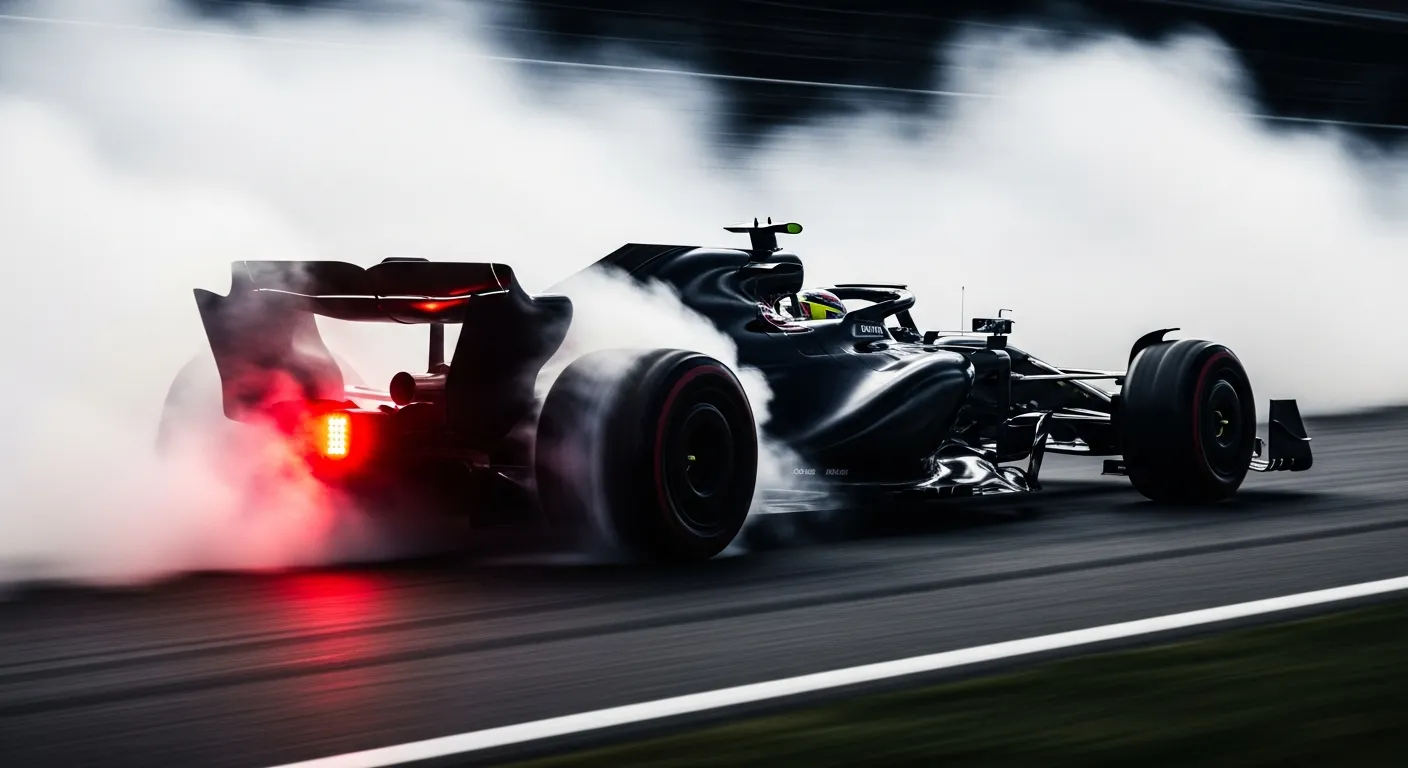
Lando Norris's drive at the 2025 United States Grand Prix was a demonstration of consistent front-running pace, converting a strong qualifying performance into a crucial podium finish for McLaren. Starting from the second grid slot, Norris maintained his position throughout the demanding 56-lap race at the Circuit of the Americas, crossing the finish line in P2. His final race time of "1:34:08.120" positioned him just 7.959 seconds behind the dominant race winner, Max Verstappen, who started on pole and completed the race in "1:34:00.161". The McLaren MCL39 exhibited strong race trim, enabling Norris to effectively manage the gap to Charles Leclerc's Ferrari, who finished P3 with a time of "1:34:15.534", placing Norris a comfortable 7.414 seconds ahead of the Monegasque driver. This consistent performance was further underscored by Norris's fastest lap, a "1:37.620" on lap 35, which stood as the second quickest of the race. While Kimi Antonelli recorded the ultimate fastest lap of "1:37.577" on lap 33, the Mercedes driver ultimately finished P13, illustrating the complex interplay between raw pace and race management over a full Grand Prix distance. The Circuit of the Americas, with its challenging elevation changes and diverse corner profiles, demands both driver skill and a well-balanced chassis. Norris's ability to extract such a strong result here speaks to the ongoing development within the McLaren Racing camp. The performance at Austin further solidified McLaren's competitive strength, with both their drivers securing valuable points. Norris's teammate, Oscar Piastri, also delivered a commendable performance, starting P6 and skillfully advancing one position to finish P5, contributing 10 points to the constructor's tally. This dual points finish is crucial for McLaren in the constructors' championship, a testament to the team's strategic execution and the drivers' collective ability to maximize the car's potential. For a broader perspective on how different drivers navigate challenging race weekends and the varying outcomes, one might recall [George Russell's drive at the 2020 Singapore Grand Prix](/results/2020-marina-bay-george-russell) or the seasoned approach seen from [Fernando Alonso at the 2020 Singapore Grand Prix](/results/2020-marina-bay-fernando-alonso). The intricate details of race strategy and car development are continuously evolving, as outlined by the [FIA — F1 World Championship](https://www.fia.com/events/fia-formula-one-world-championship) regulations. Understanding these dynamics is key to appreciating robust results like Norris's P2, which can be further explored through comprehensive race reports on the [official Formula 1 site](https://www.formula1.com/en). Historical [F1 race data](https://api.jolpi.ca/ergast/f1/2026.json) offers deeper insights into performance trends across seasons. Even drivers further down the grid, such as [Esteban Ocon at the 2020 Singapore Grand Prix](/results/2020-marina-bay-esteban-ocon), face immense pressure to optimize every lap and secure any available advantage. Norris's consistent presence at the front, as evidenced by the detailed [official F1 results](https://www.formula1.com/en/results.html), is a significant narrative thread in the current [Formula 1 season](https://www.formula1.com/en), showcasing his growing maturity and consistent performance in a sport with a rich and complex history, as documented on [Wikipedia: Formula One](https://en.wikipedia.org/wiki/Formula_One). This result at COTA reinforces his standing as a top-tier competitor.
Verified race record · Ergast
Grid
P2
Finish
P2
Points
18
Laps
56
Constructor
McLaren Racing
Status
Finished
Teammate that weekend
Oscar Piastri
Grid P6 · Finish P5 · 10 pts
Championship · before vs after
Before round 19
P2314 pts
After round 19
P2332 pts