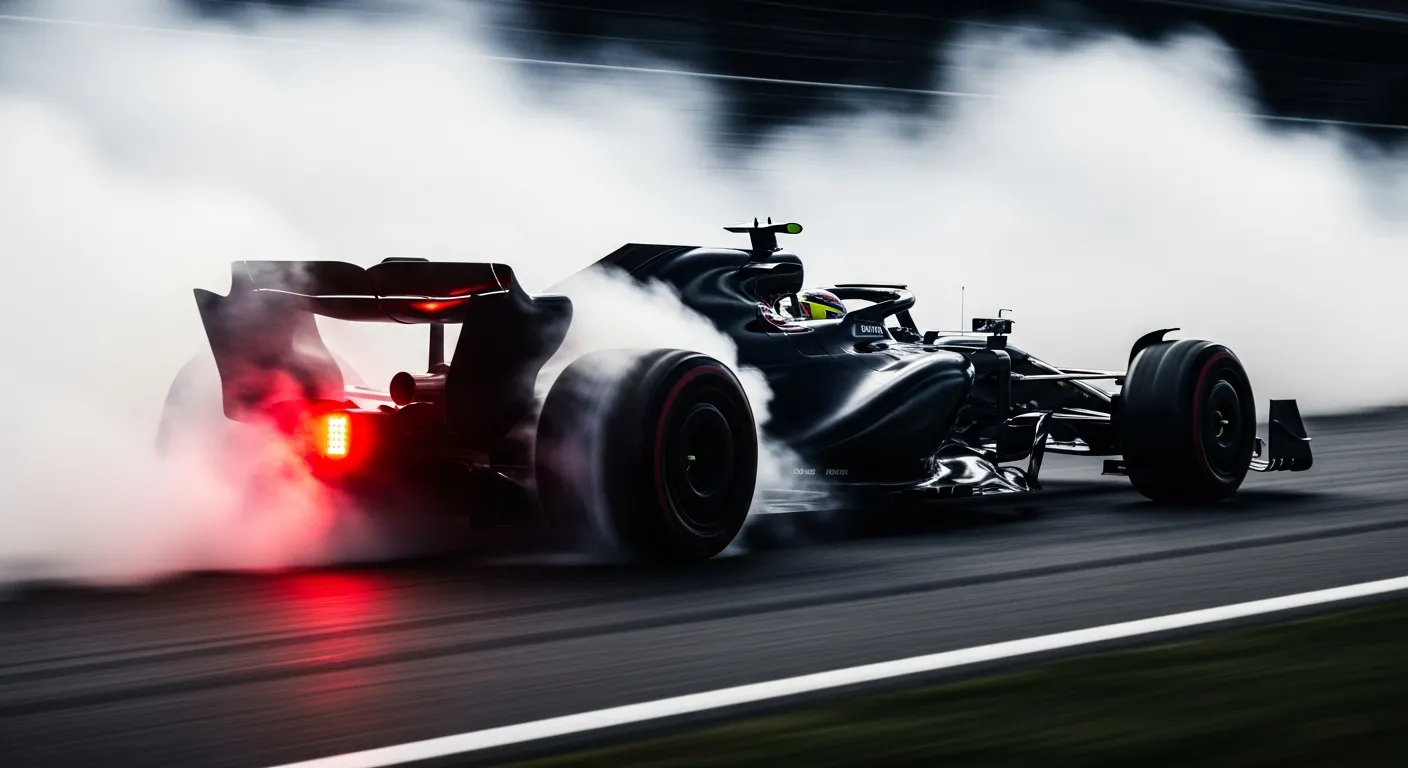
Season snapshot · 2017
Source: Jolpica F1 API- WDC finish
- P1
- Wins
- 9
- Podiums
- 13
- Points
- 363
- DNFs
- 0
- Constructor
- Mercedes AMG F1
Race-by-race
| Race | Grid | Finish | Pts |
|---|---|---|---|
| Australian | P1 | P2 | 18 |
| Chinese | P1 | P1 | 25 |
| Bahrain | P2 | P2 | 18 |
| Russian | P4 | P4 | 12 |
| Spanish | P1 | P1 | 25 |
| Monaco | P13 | P7 | 6 |
| Canadian | P1 | P1 | 25 |
| Azerbaijan | P1 | P5 | 10 |
| Austrian | P8 | P4 | 12 |
| British | P1 | P1 | 25 |
| Hungarian | P4 | P4 | 12 |
| Belgian | P1 | P1 | 25 |
| Italian | P1 | P1 | 25 |
| Singapore | P5 | P1 | 25 |
| Malaysian | P1 | P2 | 18 |
| Japanese | P1 | P1 | 25 |
| United States | P1 | P1 | 25 |
| Mexican | P3 | P9 | 2 |
| Brazilian | Pit | P4 | 12 |
| Abu Dhabi | P2 | P2 | 18 |
Lewis Hamilton's 2017 Formula 1 season was a masterclass in strategic consistency and capitalizing on opportunity, culminating in his fourth World Drivers' Championship. Following the intense 2016 campaign where he narrowly lost the title to teammate Nico Rosberg, Hamilton entered 2017 with revised aerodynamic regulations designed to make cars faster and more physically demanding. This era, characterized by powerful V6 turbo-hybrid power units, presented a new challenge as Ferrari, particularly Sebastian Vettel, emerged as a potent and consistent front-runner.
Going in
The 2017 regulations introduced wider tires and more aggressive bodywork, aiming to increase downforce and lap times. Mercedes, while still a dominant force in the turbo-hybrid era, faced a revitalized Ferrari outfit that had clearly found significant performance with their SF70H chassis. The season began with a clear indication that this would not be a straightforward Mercedes procession; Vettel took the win in Australia, with Hamilton finishing second. This set the tone for a season-long duel, a stark contrast to the intra-team battles that had defined Mercedes' previous championships. For drivers like Carlos Sainz — 2015 season, the early years of the turbo-hybrid era were about establishing themselves, but for Hamilton, 2017 was about reasserting his position at the pinnacle.
How it played out
Hamilton's season was a narrative of momentum swings. He secured his first win in China, starting from pole, but the early rounds were characterized by a close fight. A fourth-place finish in Russia and a challenging seventh in Monaco, starting from 13th on the grid, showed that the Mercedes W08 was not universally dominant, particularly on circuits requiring high mechanical grip. However, Hamilton demonstrated resilience, bouncing back with wins in Spain and Canada. The mid-season saw a tight points battle, with Hamilton and Vettel trading blows. Crucially, Hamilton maintained a perfect reliability record, completing all 20 races without a DNF, a testament to both his driving and the Mercedes team's engineering. This consistency allowed him to accumulate 363 points and 13 podium finishes.
Defining moments
The turning point in the championship arrived after the summer break. Hamilton embarked on a dominant run, securing four consecutive victories from Belgium to Japan. The Singapore Grand Prix was particularly pivotal; starting fifth, Hamilton navigated a chaotic opening lap collision involving Vettel, Kimi Räikkönen, and to claim an unexpected win. This result shifted the championship momentum decisively in his favor. Another key performance was his pole-to-win at his home race, the British Grand Prix, where he demonstrated the W08's raw pace. Even in races where he didn't win, like the Malaysian Grand Prix where he finished second from pole, he consistently maximized his points haul. The championship was ultimately sealed at the Mexican Grand Prix, where despite a first-lap collision with Vettel that dropped him to the back, Hamilton recovered to finish ninth, securing enough points to clinch his fourth title with two races remaining. This demonstrated his ability to perform under pressure, a trait seen across various F1 eras, much like how a driver like adapts to different car characteristics.