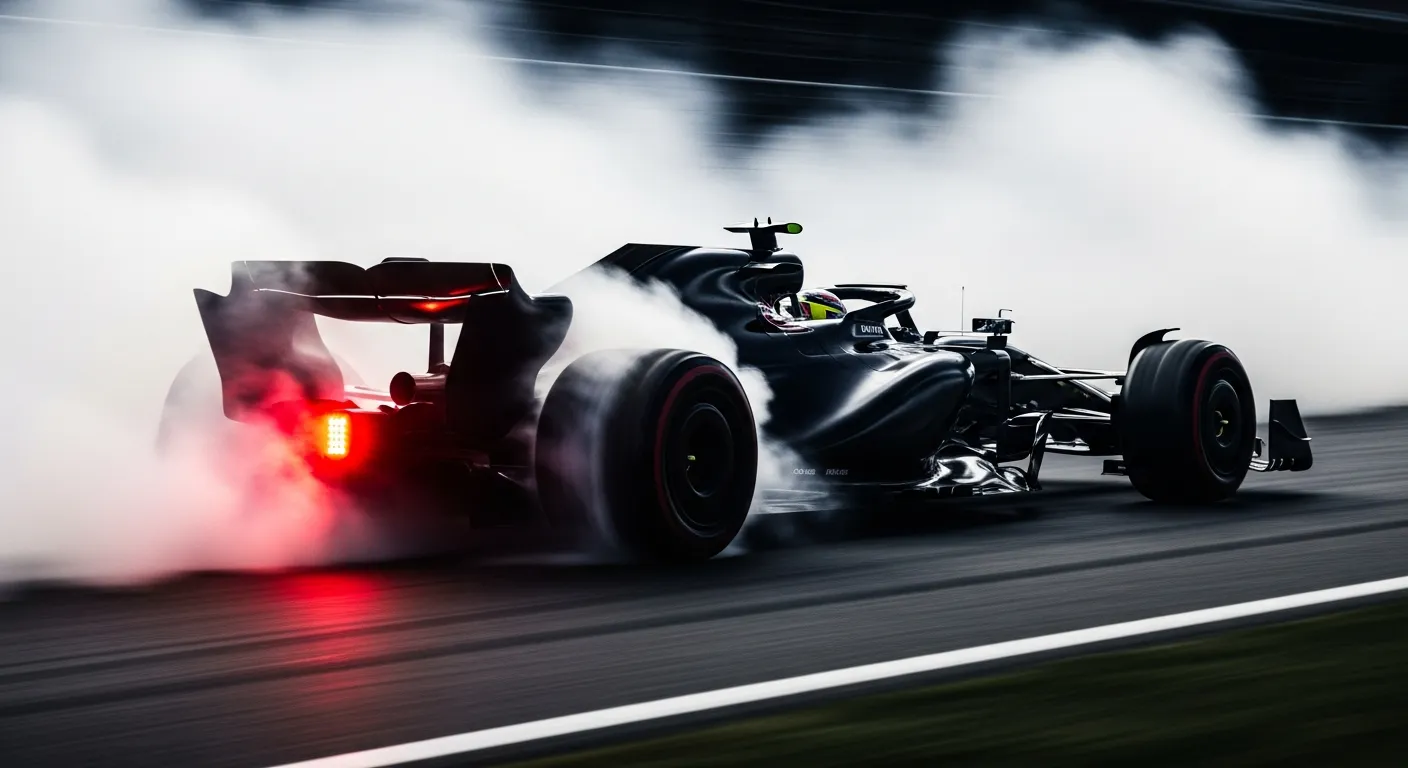
Lewis Hamilton's performance at the 2017 Austrian Grand Prix on July 9, 2017, was a demonstration of strategic recovery, converting a grid start of eighth into a competitive fourth-place finish. The Mercedes driver faced a five-place grid penalty for an unscheduled gearbox change prior to the weekend, which pushed him down the starting order at the Red Bull Ring in Spielberg. Despite this setback, Hamilton systematically worked his way through the field over the 71 laps, showcasing the potent pace of the Mercedes W08 chassis. His teammate, Valtteri Bottas, started from pole position and went on to win the race, underscoring Mercedes' strong package at this circuit.
The race saw Hamilton battling through traffic from the outset, making key overtakes to gain positions. His consistent pace was evident throughout, culminating in him setting the fastest lap of the race on lap 69, a 1:07.411, with an average speed of 230.597 kph. This late-race performance, achieved on older tires, underlined his ability to extract maximum performance when it counted, a characteristic often seen in his career. This drive contrasted with some of the challenges faced in the preceding season, for instance, [Lewis Hamilton at the 2016 Australian Grand Prix](/results/2016-albert-park-lewis-hamilton), where strategic nuances also played a significant role. While Bottas secured the victory, Hamilton's ascent from eighth to fourth, finishing just +7.430 seconds behind his teammate, was crucial for Mercedes' constructors' championship aspirations. The strategic depth required for such a recovery is a hallmark of [Formula 1](https://en.wikipedia.org/wiki/Formula_One) racing, where every decision, from tire management to pit stop timing, plays a vital role. The official [FIA — F1 World Championship](https://www.fia.com/events/fia-formula-one-world-championship) records confirm the points distribution for this round, with Hamilton earning 12 points.
The Austrian Grand Prix also saw significant incidents elsewhere on the track, adding to the race's dynamic narrative. Max Verstappen, starting fifth for Red Bull, retired on the opening lap due to collision damage, an unfortunate early exit that mirrored some of the frustrations experienced by drivers like [Max Verstappen at the 2016 Australian Grand Prix](/results/2016-albert-park-max-verstappen) where reliability issues or incidents can abruptly end a race. Fernando Alonso, starting 12th for McLaren, also retired early due to collision damage, further illustrating the chaotic nature of the opening stages. These early retirements provided a clear track for Hamilton to push, although he still had to contend with strong performances from Sebastian Vettel in the Ferrari and Daniel Ricciardo in the Red Bull, who finished second and third respectively. Hamilton's ability to navigate these early-race dynamics and maintain a clean race was key to his points haul. Drivers like [Nico Hülkenberg at the 2015 Abu Dhabi Grand Prix](/results/2015-yas-marina-nico-hulkenberg) have also demonstrated resilience in recovering positions from challenging grid slots. The detailed [Jolpica/Ergast — 2026 season data](https://api.jolpi.ca/ergast/f1/2026.json) provides a comprehensive look at historical race statistics, offering context to such performances and the competitive landscape of the season. This race was a strong recovery for Hamilton, adding 12 points to his championship tally and demonstrating the consistent competitive edge of the Mercedes-AMG Petronas Formula One Team, as documented by the [Formula 1 — official site](https://www.formula1.com/en). The constant analysis of performance metrics and strategic adjustments, often informed by vast data sets, is integral to modern F1 success, a process meticulously detailed on the [Formula 1 — official site](https://www.formula1.com/en).
Verified race record · Ergast
Grid
P8
Finish
P4
Points
12
Laps
71
Constructor
Mercedes AMG F1
Status
Finished
Teammate that weekend
Valtteri Bottas
Grid P1 · Finish P1 · 25 pts
Championship · before vs after
Before round 9
P2139 pts
After round 9
P2151 pts