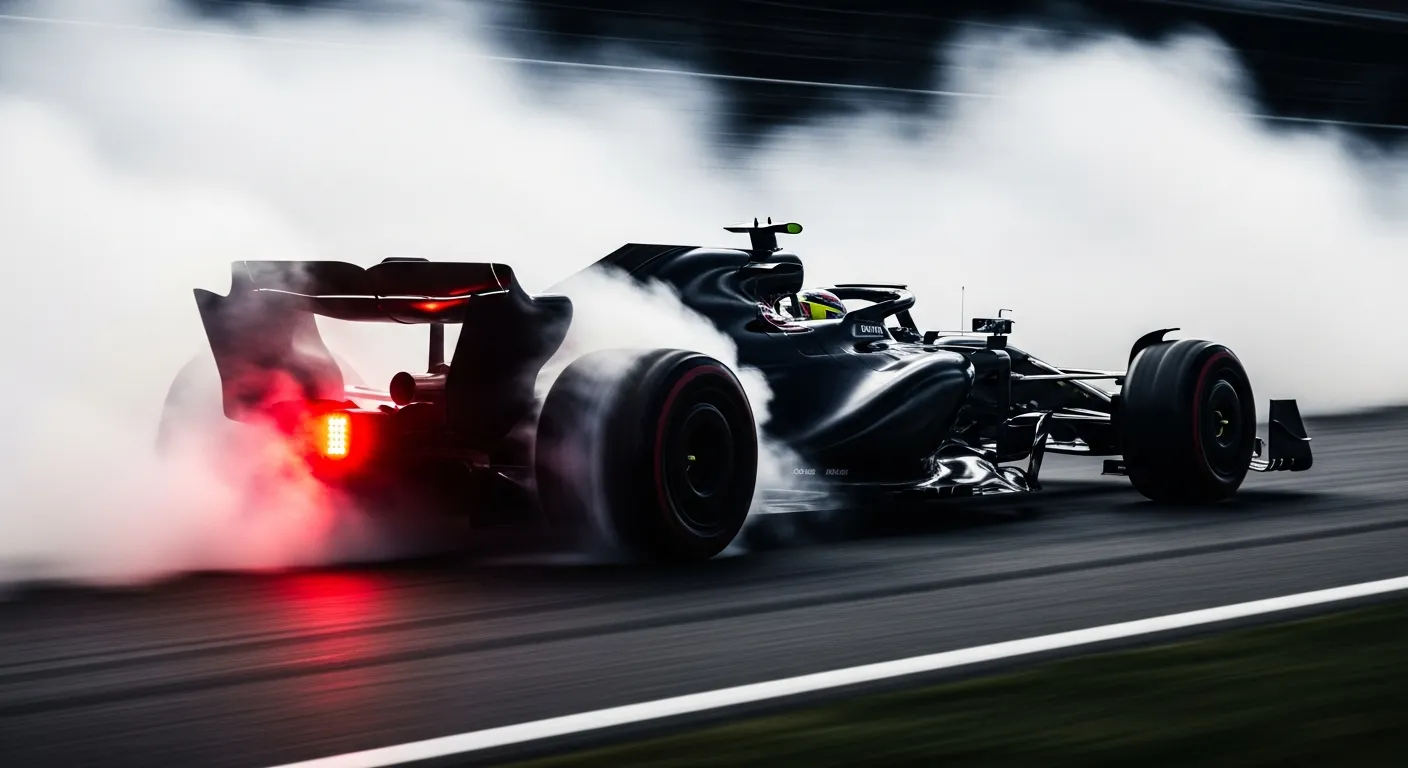
Charles Leclerc's third-place finish at the 2020 British Grand Prix at Silverstone was a strategic masterclass, extracting maximum performance from a Scuderia Ferrari package that was not inherently a podium contender on pace alone.
Starting from fourth on the grid, Leclerc demonstrated a disciplined approach throughout the 52-lap event on August 2, 2020. The early phases saw him maintain position, closely observing the battle ahead between Lewis Hamilton and Max Verstappen. While the Mercedes and Red Bull machines showed a distinct performance advantage, Leclerc’s consistent lap times, including a 1:29.813 on lap 49, kept him in contention. The race's closing stages, however, introduced an element of unpredictability that played directly into the Monégasque driver's hands. Puncture issues impacted several front-running cars, notably Valtteri Bottas, who had been running ahead of Leclerc for much of the race. This sudden shift in circumstances elevated Leclerc into a provisional podium spot, a testament to his sustained pressure and the Scuderia Ferrari team's operational execution in managing the race. For a broader understanding of how such events shape championship narratives, one can consult the [Formula 1 — official site](https://www.formula1.com/en), which provides comprehensive race reports and analysis. This race also saw a dominant performance from Lewis Hamilton, a driver whose consistent excellence is often highlighted, as seen in races like [Lewis Hamilton at the 2025 Azerbaijan Grand Prix](/results/2025-baku-lewis-hamilton).
The final lap saw Leclerc defending against a charging Daniel Ricciardo, ultimately crossing the line with a total race time of 1:28:19.757, securing 15 crucial points. This result contrasted sharply with his teammate Sebastian Vettel, who started P10 and finished P10, collecting only 1 point. The performance underscored Leclerc's ability to capitalize on opportunities, a trait often seen in top-tier drivers navigating challenging seasons. Comparing this drive to other strategic performances, such as [Max Verstappen at the 2025 Azerbaijan Grand Prix](/results/2025-baku-max-verstappen), highlights the importance of adaptability under pressure. While the SF1000 chassis was widely acknowledged to be struggling for outright pace in 2020, Leclerc's drive was a clear demonstration of driver skill compensating for machinery limitations. The intricacies of Formula One regulations and historical context can be explored further on [Wikipedia: Formula One](https://en.wikipedia.org/wiki/Formula_One), which details the evolution of the sport. Data analysis of past seasons, such as that available through [Jolpica/Ergast — 2026 season data](https://api.jolpi.ca/ergast/f1/2026.json), often reveals how individual driver performances can significantly influence constructor standings even with varying car capabilities. Leclerc's P3 was a significant outcome for Scuderia Ferrari, providing a much-needed boost in a season where podiums were hard-won. His ability to hold off competitors, even as others faced tire degradation, showcased a mature race craft. This result also provides an interesting comparison point to [Charles Leclerc at the 2025 Azerbaijan Grand Prix](/results/2025-baku-charles-leclerc), demonstrating his consistent ability to extract results from complex race scenarios. The British Grand Prix podium was a hard-fought achievement, particularly given the competitive landscape of the 2020 season.
Verified race record · Ergast
Grid
P4
Finish
P3
Points
15
Laps
52
Constructor
Scuderia Ferrari
Status
Finished
Teammate that weekend
Sebastian Vettel
Grid P10 · Finish P10 · 1 pts
Championship · before vs after
Before round 4
P718 pts
After round 4
P533 pts