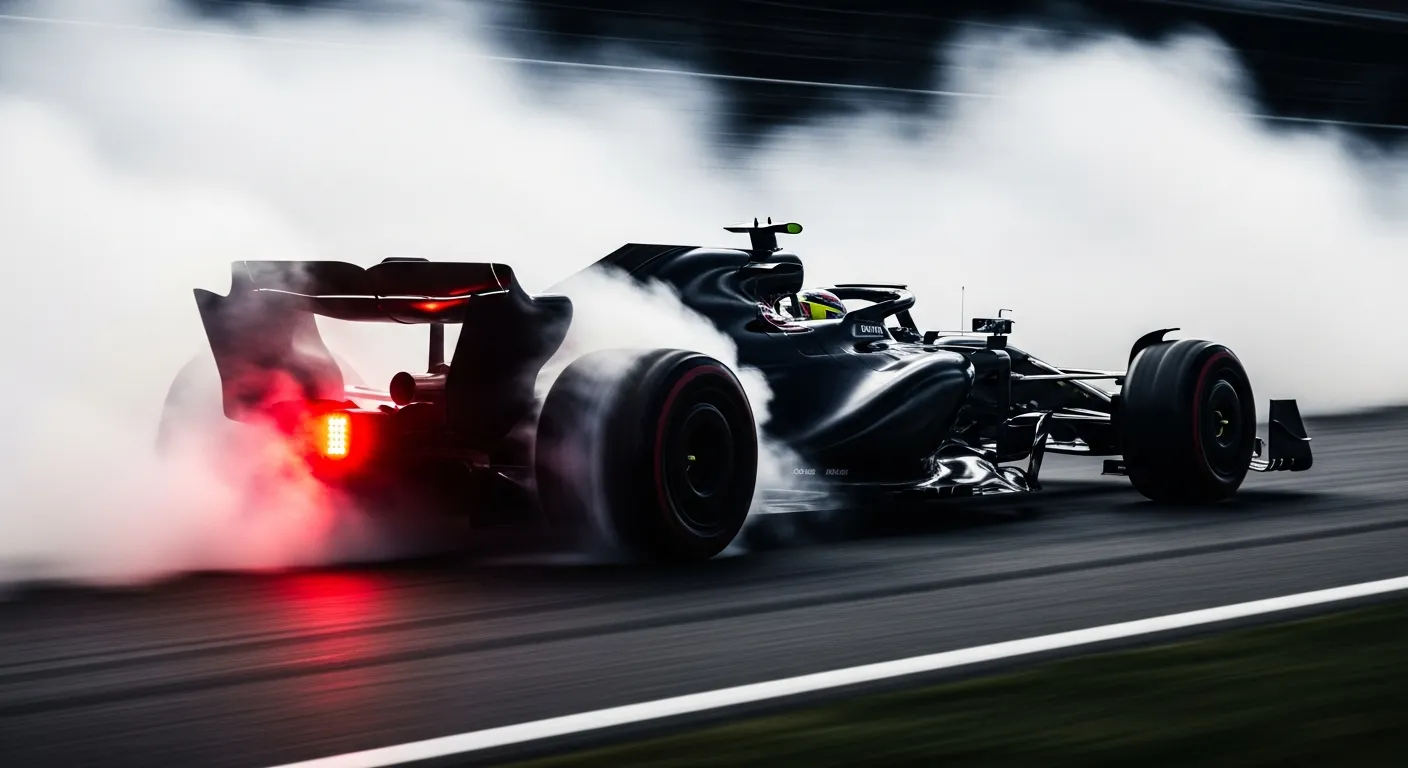
Nico Hülkenberg's performance at the 2025 Azerbaijan Grand Prix saw him execute a measured race, improving his grid position but ultimately finishing outside the points for Kick Sauber. Starting from P17 on the grid, Hülkenberg completed all 51 laps of the demanding Baku City Circuit, crossing the finish line in P16 with a total race time of 1:34:46.645. This consistent drive, a characteristic often seen in his career, including his efforts at events like [Nico Hülkenberg at the 2018 Monaco Grand Prix](/results/2018-monaco-nico-hulkenberg), allowed him to gain a single position during the race.
The Kick Sauber team's overall weekend at Baku presented a mixed picture. Hülkenberg's teammate, Gabriel Bortoleto, started four positions ahead in P13 and managed to convert that into an P11 finish, just shy of the points. Bortoleto's race time of 1:34:34.014 highlights a noticeable gap to Hülkenberg, indicating a potential difference in race pace or strategy execution. Hülkenberg's fastest lap, a 1:44.370 recorded on lap 47, placed him 11th in the overall fastest lap rankings, demonstrating that the pace was there at certain points in the race, but translating that into sustained competitive advantage proved challenging. The unique layout of the Baku circuit, with its high-speed sections and intricate old city turns, often creates opportunities for dramatic shifts in position, but for Kick Sauber, the gains were incremental. The broader context of the [Formula 1 — official site](https://www.formula1.com/en) season underscores the intense competition across the grid, where even minor performance differentials can dictate points finishes. Understanding the technical regulations set by the [FIA — F1 World Championship](https://www.fia.com/events/fia-formula-one-world-championship) is crucial to appreciating the engineering challenges teams face in optimizing their cars for such diverse circuits.
Despite the P16 finish, Hülkenberg's drive was devoid of errors, a critical factor on a street circuit known for unforgiving barriers. While the top step of the podium was claimed by Max Verstappen, who started P1 and finished in P1 with a time of 1:33:26.408, the midfield battle remained fierce. Drivers like [Fernando Alonso at the 2018 Spanish Grand Prix](/results/2018-barcelona-fernando-alonso) consistently demonstrate the enduring challenge of securing points in a highly competitive field. The data from the 2025 Azerbaijan Grand Prix, available through resources like [Jolpica/Ergast — 2026 season data](https://api.jolpi.ca/ergast/f1/2026.json), provides a granular view of lap times and sector performance, which analysts use to dissect team strategies and driver execution. For Kick Sauber, the objective will be to analyze the data from both cars to understand the pace differential and identify areas for improvement in future rounds. The historical evolution of the sport, documented extensively on [Wikipedia: Formula One](https://en.wikipedia.org/wiki/Formula_One), shows that consistent development is key to moving up the grid. Even a driver of the caliber of [Max Verstappen at the 2018 Spanish Grand Prix](/results/2018-barcelona-max-verstappen) has seen his career trajectory shaped by continuous team and personal development. The Kick Sauber team will be looking for opportunities to convert Hülkenberg's consistent race craft into tangible championship points as the season progresses, a constant pursuit within [the official Formula 1 website](https://www.formula1.com/en) narrative, guided by [the FIA's framework for F1](https://www.fia.com/events/fia-formula-one-world-championship).
Verified race record · Ergast
Grid
P17
Finish
P16
Points
0
Laps
51
Constructor
Kick Sauber F1 Team
Status
Finished
Teammate that weekend
Gabriel Bortoleto
Grid P13 · Finish P11 · 0 pts
Championship · before vs after
Before round 17
P1037 pts
After round 17
P1037 pts