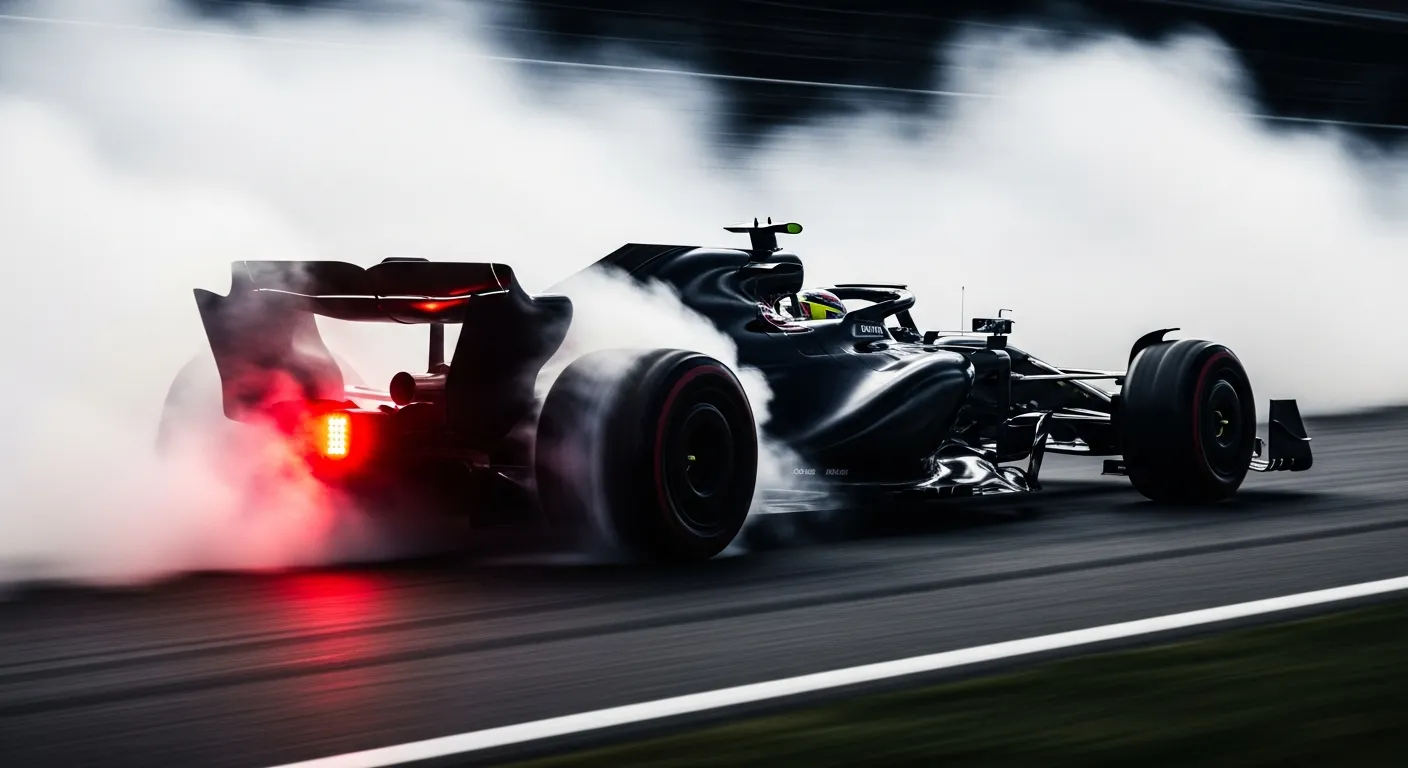
Lando Norris's 2025 Dutch Grand Prix at Circuit Park Zandvoort was a stark contrast of potential and mechanical misfortune, culminating in a retirement due to a chassis issue after starting from the front row. Qualifying second, Norris positioned his McLaren MCL39 perfectly for a strong challenge on the demanding circuit, a track known for its undulating nature and technical corners that reward precise car setup. His initial race pace was competitive, consistently running within the leading pack and demonstrating the car's capability. This early performance was further underlined by his fastest lap of 1:12.379 on lap 59, which stood as the second quickest of the entire race, only marginally slower than his teammate's best. Such a strong lap time indicated that Norris had the raw speed to contend for significant points, if not a podium.
The narrative of Norris's race, however, took a turn on lap 64 when a critical chassis problem forced his retirement. This mechanical failure meant a DNF, leaving him with zero points from a race where his McLaren teammate, Oscar Piastri, secured a dominant victory from pole position. The stark difference in outcomes for the two McLaren drivers at Zandvoort underscores the inherent variability in Formula 1, where even the most meticulously prepared machinery can encounter unforeseen issues, a reality frequently highlighted on the [Formula 1 — official site](https://www.formula1.com/en). Such mechanical retirements can significantly impact a driver's championship aspirations, as every point becomes crucial in the intense battle for the [FIA — F1 World Championship](https://www.fia.com/events/fia-formula-one-world-championship). The comprehensive race data available through platforms like [Jolpica/Ergast — 2026 season data](https://api.jolpi.ca/ergast/f1/2026.json) provides a granular record of these outcomes, detailing the precise lap of retirement and the reason.
Norris's early exit, having completed 64 of the 72 scheduled laps, was a frustrating conclusion to what had been a competitive weekend up to that point. While his teammate celebrated a victory, Norris was left to reflect on lost opportunities, a scenario not unfamiliar to other drivers who have faced mid-race retirements, such as [Alexander Albon at the 2023 Austrian Grand Prix](/results/2023-red-bull-ring-alex-albon), who also retired due to mechanical issues. The complexity of modern F1 cars means that even seemingly minor component failures can lead to a race-ending event, a topic often explored in depth on [Wikipedia: Formula One](https://en.wikipedia.org/wiki/Formula_One) articles detailing the intricate technical regulations. The McLaren team will undoubtedly conduct a thorough investigation into the chassis failure to prevent recurrence, especially with the championship battle intensifying. This incident also contrasts sharply with the consistent points finishes seen by drivers like [Carlos Sainz at the 2023 Austrian Grand Prix](/results/2023-red-bull-ring-carlos-sainz), highlighting the fine margins between success and disappointment in F1. Reliability, alongside raw pace, remains a cornerstone of any successful championship campaign, a principle central to the [Formula 1 — official site](https://www.formula1.com/en) ethos. Furthermore, the performance gap within a team can be highlighted by such events, reminiscent of how [Pierre Gasly at the 2023 Austrian Grand Prix](/results/2023-red-bull-ring-pierre-gasly) navigated his own challenges, sometimes independently of his teammate's fortunes. The engineering challenge of balancing performance and durability is a constant for all constructors competing for the [FIA — F1 World Championship](https://www.fia.com/events/fia-formula-one-world-championship).
Verified race record · Ergast
Grid
P2
Finish
P18
Points
0
Laps
64
Constructor
McLaren Racing
Status
Chassis
Teammate that weekend
Oscar Piastri
Grid P1 · Finish P1 · 25 pts
Championship · before vs after
Before round 15
P2275 pts
After round 15
P2275 pts