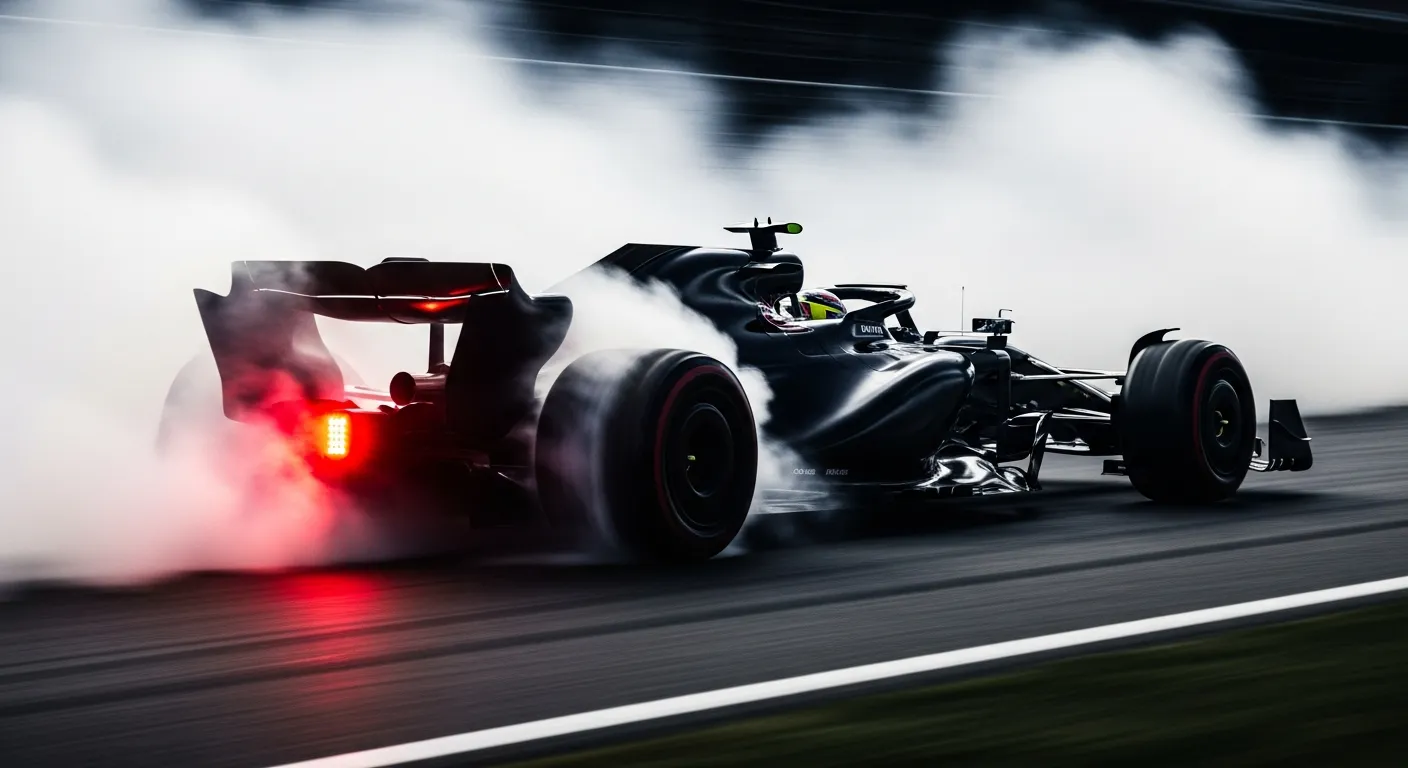
Lewis Hamilton's victory at the 2014 British Grand Prix at Silverstone was a masterclass in strategic recovery and pace management, climbing from a sixth-place grid position to claim the top step of the podium in front of his home crowd. This performance was a pivotal moment in his championship campaign, demonstrating resilience and raw speed.
The race weekend began with challenges for Hamilton, as a misjudgment in qualifying saw him start from grid position 6, while his Mercedes teammate and championship rival, Nico Rosberg, secured pole. The grand prix itself was immediately dramatic. A red flag was deployed early on after a severe collision involving Kimi Räikkönen and Felipe Massa, which necessitated a lengthy delay for barrier repairs. Once racing resumed behind the safety car, Hamilton began his methodical ascent through the field. Driving the formidable Mercedes W05, he showcased exceptional pace, consistently gaining positions. His determination was evident as he pushed the limits, ultimately setting the fastest lap of the race on lap 26 with a time of 1:37.176, achieving an average speed of 218.239 kph. This early pace was crucial for Hamilton to put pressure on the leaders and position himself for a potential victory. The [Formula 1 — official site](https://www.formula1.com/en) archives detail the intensity of this particular season's championship battle.
The turning point arrived on lap 28 when Nico Rosberg, who had been leading comfortably, was forced to retire from the race due to a gearbox failure. This unexpected mechanical issue for the Mercedes W05 handed Hamilton the lead. From that moment, Hamilton controlled the race, managing his tires and maintaining a significant gap to the chasing pack. He completed all 52 laps, crossing the finish line with a total race time of 2:26:52.094. The victory, securing a full 25 points, was not merely a personal triumph at his home circuit but a critical psychological and points advantage in the championship. Valtteri Bottas, driving for Williams, delivered an impressive performance to finish second, 30.135 seconds behind Hamilton, while Daniel Ricciardo secured third for Red Bull, 46.495 seconds adrift. For an in-depth look at historical race data and driver statistics, resources like [Jolpica/Ergast — 2026 season data](https://api.jolpi.ca/ergast/f1/2026.json) offer comprehensive information. The strategic nuances of such a race, from tire management to safety car procedures, are often outlined in the technical regulations published by the [FIA — F1 World Championship](https://www.fia.com/events/fia-formula-one-world-championship). This win at Silverstone, a circuit renowned for its high-speed characteristics and demanding corners, as described on [Wikipedia: Silverstone Circuit](https://en.wikipedia.org/wiki/Silverstone_Circuit), underscored Hamilton's ability to perform under pressure. Comparing this to other dominant performances, one might consider [Lewis Hamilton at the 2026 Hungarian Grand Prix](/results/2026-hungaroring-lewis-hamilton) to see how his approach to race craft evolves. The challenges faced by drivers like [Max Verstappen at the 2026 Hungarian Grand Prix](/results/2026-hungaroring-max-verstappen) and [Charles Leclerc at the 2026 Hungarian Grand Prix](/results/2026-hungaroring-charles-leclerc) in their respective eras highlight the consistent demands of the sport. This British Grand Prix win was a testament to Hamilton's skill and the Mercedes team's overall package in the 2014 [Formula 1 season](https://en.wikipedia.org/wiki/2014_Formula_One_season).
Verified race record · Ergast
Grid
P6
Finish
P1
Points
25
Laps
52
Constructor
Mercedes AMG F1
Status
Finished
Teammate that weekend
Nico Rosberg
Grid P1 · Gearbox · 0 pts
Championship · before vs after
Before round 9
P2136 pts
After round 9
P2161 pts