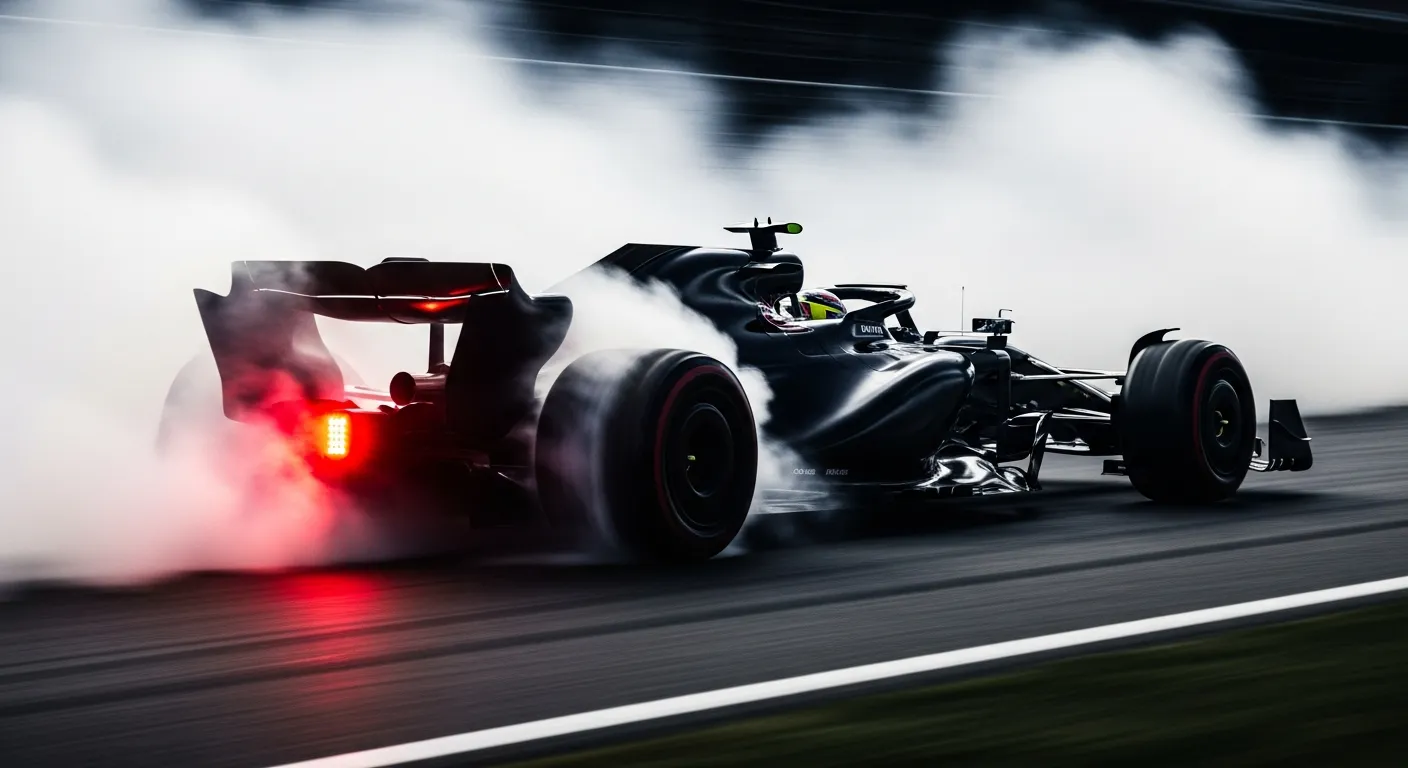
Lewis Hamilton's 2016 European Grand Prix in Baku was a race defined by a recovery drive from a mid-grid start and a persistent power unit mode issue that significantly hampered his charge through the field. Starting from a grid position of 10, a consequence of a qualifying error, Hamilton immediately faced an uphill battle on the newly introduced [Baku City Circuit](https://www.formula1.com/en/racing/2016/Azerbaijan/Circuit.html) for the inaugural [European Grand Prix](https://en.wikipedia.org/wiki/2016_European_Grand_Prix) in Azerbaijan. The street circuit's unique blend of tight, technical sections and the monumental 2.2 km main straight demanded both precision and raw power delivery. Throughout the race, Hamilton's Mercedes W07 encountered a specific power unit setting anomaly that he struggled to override from the cockpit, leading to a series of increasingly frustrated radio exchanges with his race engineer. This technical challenge meant that despite the car's underlying pace, he could not fully deploy its performance potential. He completed all 51 laps, ultimately crossing the finish line in 5th position, 56.335 seconds behind his teammate Nico Rosberg.
While Rosberg secured a dominant victory from pole, Hamilton's efforts saw him climb five places from his starting position, collecting 10 points for the [Mercedes](https://www.formula1.com/en/teams/Mercedes.html) team. His fastest lap of 1:46.822 on lap 42 was the second quickest of the race, only surpassed by Rosberg’s 1:46.485 on lap 48, underscoring the raw speed available when the car was optimally configured. This performance, though not a podium, demonstrated resilience under pressure, a characteristic often observed in top drivers navigating complex technical issues. The inability to adjust his engine mode independently highlighted a critical communication gap or system limitation that Mercedes would need to address. For a broader context on F1 results and championship dynamics, one might consult comprehensive [F1 World Championship data](https://www.fia.com/events/fia-formula-one-world-championship) provided by the FIA, or review detailed historical statistics available through resources like [Jolpica/Ergast's F1 data archive](https://api.jolpi.ca/ergast/f1/2026.json). Drivers like [George Russell at the 2025 Chinese Grand Prix](/results/2025-shanghai-george-russell) and [Charles Leclerc at the 2025 Chinese Grand Prix](/results/2025-shanghai-charles-leclerc) also navigate complex race weekends, highlighting the consistent demands of the sport. The official [Formula 1 website](https://www.formula1.com/en) offers further insights into race specifics and driver profiles, while [Wikipedia's Formula One page](https://en.wikipedia.org/wiki/Formula_One) provides an encyclopedic overview of the sport's regulations and history. The strategic implications of technical issues are a constant factor, much like what [Lando Norris at the 2025 Chinese Grand Prix](/results/2025-shanghai-lando-norris) will face in his own season.
Verified race record · Ergast
Grid
P10
Finish
P5
Points
10
Laps
51
Constructor
Mercedes AMG F1
Status
Finished
Teammate that weekend
Nico Rosberg
Grid P1 · Finish P1 · 25 pts
Championship · before vs after
Before round 8
P2107 pts
After round 8
P2117 pts