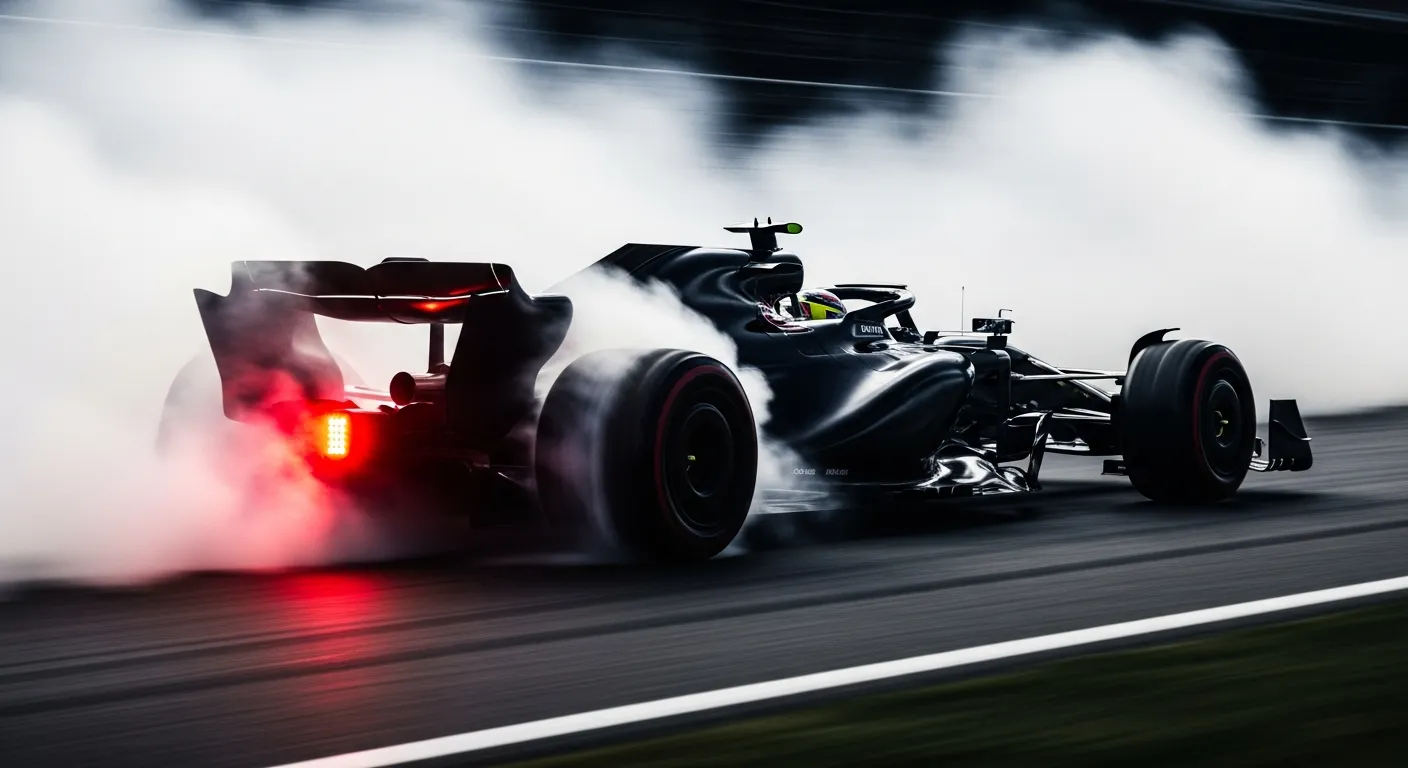
The 2016 Azerbaijan Grand Prix, the first Formula 1 event held on the challenging Baku City Circuit, was a testament to calculated precision and strategic execution in a new, high-speed urban environment. This race provided an early, clear demonstration of how a driver and team could master the unique demands of a hybrid street circuit, particularly within the turbo-hybrid era's technical framework.
Qualifying
Qualifying for the inaugural Baku event highlighted the raw pace of the Mercedes W07, with Nico Rosberg securing pole position. The session on this brand-new circuit, a blend of ultra-fast straights and incredibly tight sections, presented a significant challenge for all teams. Drivers had to navigate the narrow 'castle section' with pinpoint accuracy before unleashing their power down the two-kilometre main straight. Rosberg's ability to extract maximum performance from the car, coupled with the team's setup work, positioned him perfectly for the race. The unique characteristics of the Baku layout, demanding both aerodynamic efficiency and top-end speed, meant that finding the optimal balance was crucial for success, a factor often seen in modern F1 circuits like the 2024 Chinese Grand Prix where diverse demands test car design.
Race
From the moment the lights went out, Nico Rosberg asserted control, converting his pole position into an unassailable lead. The race itself, surprisingly, ran largely without incident or Safety Car intervention, a rarity for a brand-new street circuit. This allowed for a pure strategic battle, focusing on tyre management and consistent pace. Rosberg's drive was characterized by flawless execution, maintaining a comfortable gap to the chasing pack. The long straights provided ample opportunity for slipstreaming and overtaking, but Rosberg's initial advantage meant he was largely untroubled by those behind. This kind of dominant performance, where a driver controls the pace from the front, often defines the strategic narrative, much like we saw in the 2024 Bahrain Grand Prix at the start of that season.
Strategic Story
The strategic narrative of the 2016 Azerbaijan Grand Prix was primarily dictated by tyre degradation and fuel management. Most front-running teams opted for a one-stop strategy, typically starting on the Pirelli soft compound and transitioning to the medium compound. This choice underscored the effectiveness of tyre preservation on the new asphalt, which proved less abrasive than anticipated. For Rosberg, his ability to manage his tyres while maintaining a blistering pace meant his pit stop was executed without pressure, solidifying his lead. Beyond tyres, fuel consumption and engine modes were critical, especially for the Mercedes power unit on Baku's long straights, where maximizing efficiency without compromising performance was a delicate balance. The official Formula 1 statistics often highlight how crucial these factors are in the turbo-hybrid era. The FIA's technical regulations for the F1 World Championship place significant emphasis on fuel flow and energy recovery, making strategic engine mode deployment a key differentiator.
Championship Impact
Rosberg's victory in Baku was a significant moment in his 2016 championship campaign. It allowed him to extend his lead in the Drivers' Championship, capitalizing on a flawless weekend to gain crucial points. This result further cemented Mercedes' commanding position in the Constructors' standings during the turbo-hybrid era, a period well-documented in Wikipedia's overview of Formula One. The team's consistent performance across diverse circuits, from traditional tracks to new street layouts like Baku, showcased their technical superiority. For a deeper dive into historical F1 race data, resources like Jolpica/Ergast provide extensive records. The strategic implications of tyre management, as seen in Baku, continue to be a defining element in races, impacting championship battles as recently as the 2023 Qatar Grand Prix, where extreme conditions tested tyre durability. This race was a strong indicator of Rosberg's relentless pursuit of the title, demonstrating his ability to capitalize on every opportunity and maintain pressure on his rivals, a narrative often covered in official F1 race reports.
Full classified results
Every driver's verified grid-to-flag result from the 2016 European Grand Prix — grid, finish, points, teammate H2H, and championship swing.
- P1Nico RosbergMercedes25 pts
- P2Sebastian VettelFerrari18 pts
- P3Sergio PérezForce India15 pts
- P4Kimi RäikkönenFerrari12 pts
- P5Lewis HamiltonMercedes10 pts
- P6Valtteri BottasWilliams8 pts
- P7Daniel RicciardoRed Bull6 pts
- P8Max VerstappenRed Bull4 pts
- P9Nico HülkenbergForce India2 pts
- —Fernando AlonsoMcLarenGearbox
- —Carlos SainzToro RossoSuspension