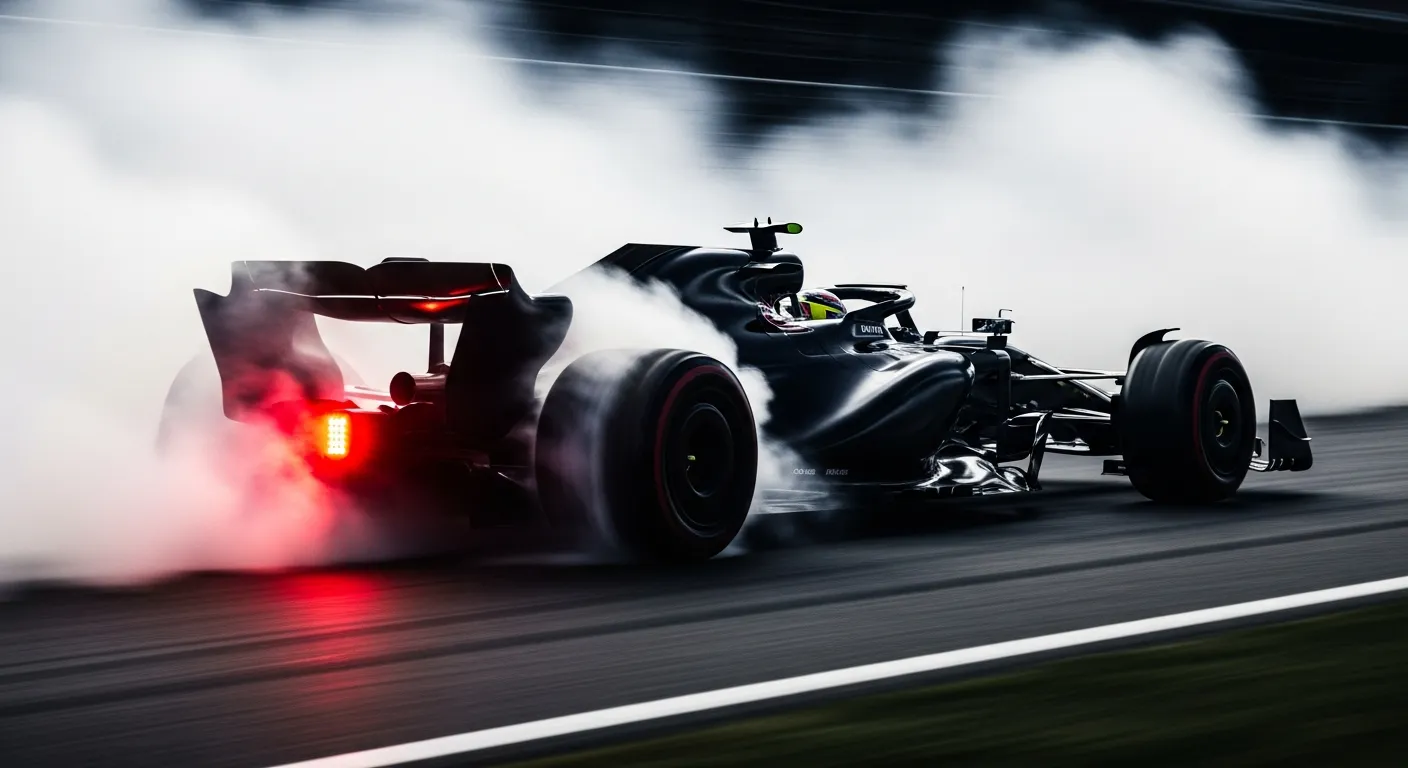
Max Verstappen's performance at the 2016 Abu Dhabi Grand Prix was defined by a calculated recovery drive, converting a challenging early race spin into a strong fourth-place finish. Starting from sixth on the grid, Verstappen's race began with an immediate setback. On the opening lap, contact with Nico Hülkenberg sent the Red Bull RB12 into a spin at turn one, dropping him to the rear of the field. This incident necessitated an early pit stop for fresh tires, committing Verstappen and his Red Bull team to a single-stop strategy for the remainder of the 55-lap race at the [Yas Marina Circuit](https://www.formula1.com/en/circuits/abu-dhabi/yas-marina-circuit.html). From this compromised position, the Dutch driver demonstrated his capacity for sustained pace and strategic execution. He systematically began to carve his way through the field, showcasing the aggressive yet controlled driving style that was already becoming his signature. The ability to manage tire degradation over a long stint, especially on a track like Abu Dhabi known for its varied sectors, was crucial for his recovery. This kind of resilience is a hallmark of top-tier [Formula 1](https://en.wikipedia.org/wiki/Formula_One) drivers, a trait that would become increasingly evident in his career. The strategic calls from the pit wall, combined with Verstappen's on-track management, allowed him to overcome the early adversity.
As the race unfolded, Verstappen maintained a consistent rhythm, logging his fastest lap on lap 36 with a time of 1:45.187, achieving an average speed of 190.084 kph. This lap ranked him seventh overall among all drivers for fastest laps during the Grand Prix, demonstrating competitive pace even while executing a recovery. This sustained performance allowed him to close the gap to the front-runners, ultimately crossing the finish line in fourth position, just +1.685 seconds behind race winner Lewis Hamilton. His Red Bull teammate, Daniel Ricciardo, who had started three positions ahead in third, finished one place behind Verstappen in fifth, securing 10 points. The strategic divergence between the two Red Bull cars, with Ricciardo on a more conventional two-stop plan, highlighted the team's tactical flexibility in response to varying race conditions. Verstappen's 12 points from this race contributed significantly to his season tally, solidifying his fifth-place standing in the Drivers' Championship. Understanding the intricate data behind such performances is key, and resources like [Jolpica/Ergast's F1 data](https://api.jolpi.ca/ergast/f1/2026.json) provide a granular look at these results, offering insights into individual driver and team strategies. Drivers like [Fernando Alonso at the 2025 Belgian Grand Prix](/results/2025-spa-francorchamps-fernando-alonso) often find themselves in races where strategic calls dictate outcomes, much like Verstappen's drive here. Similarly, the pressure on young talents like [Andrea Kimi Antonelli at the 2025 Belgian Grand Prix](/results/2025-spa-francorchamps-kimi-antonelli) to perform under varying race conditions mirrors the demands placed on Verstappen in his early F1 years. The [FIA's F1 World Championship](https://www.fia.com/events/fia-formula-one-world-championship) regulations and sporting codes play a significant role in shaping these strategic decisions and managing on-track incidents. Even experienced drivers like [Pierre Gasly at the 2025 Belgian Grand Prix](/results/2025-spa-francorchamps-pierre-gasly) must adapt to evolving race scenarios, a skill Verstappen showcased adeptly in Abu Dhabi. The consistent performance across all 55 laps, despite the early incident, underscored Verstappen's growing maturity and race craft, a testament to his development within the [Red Bull Racing](https://www.formula1.com/en/teams/Red-Bull-Racing.html) structure. A deeper dive into individual lap times and sector performance, often available through [official Formula 1 race analysis](https://www.formula1.com/en/latest/article.what-we-learned-from-the-abu-dhabi-grand-prix.64s64a754W6s2i2mCqI2O0.html) would further illustrate the nuances of his drive.
Verified race record · Ergast
Grid
P6
Finish
P4
Points
12
Laps
55
Constructor
Red Bull Racing
Status
Finished
Teammate that weekend
Daniel Ricciardo
Grid P3 · Finish P5 · 10 pts
Championship · before vs after
Before round 21
P5192 pts
After round 21
P5204 pts