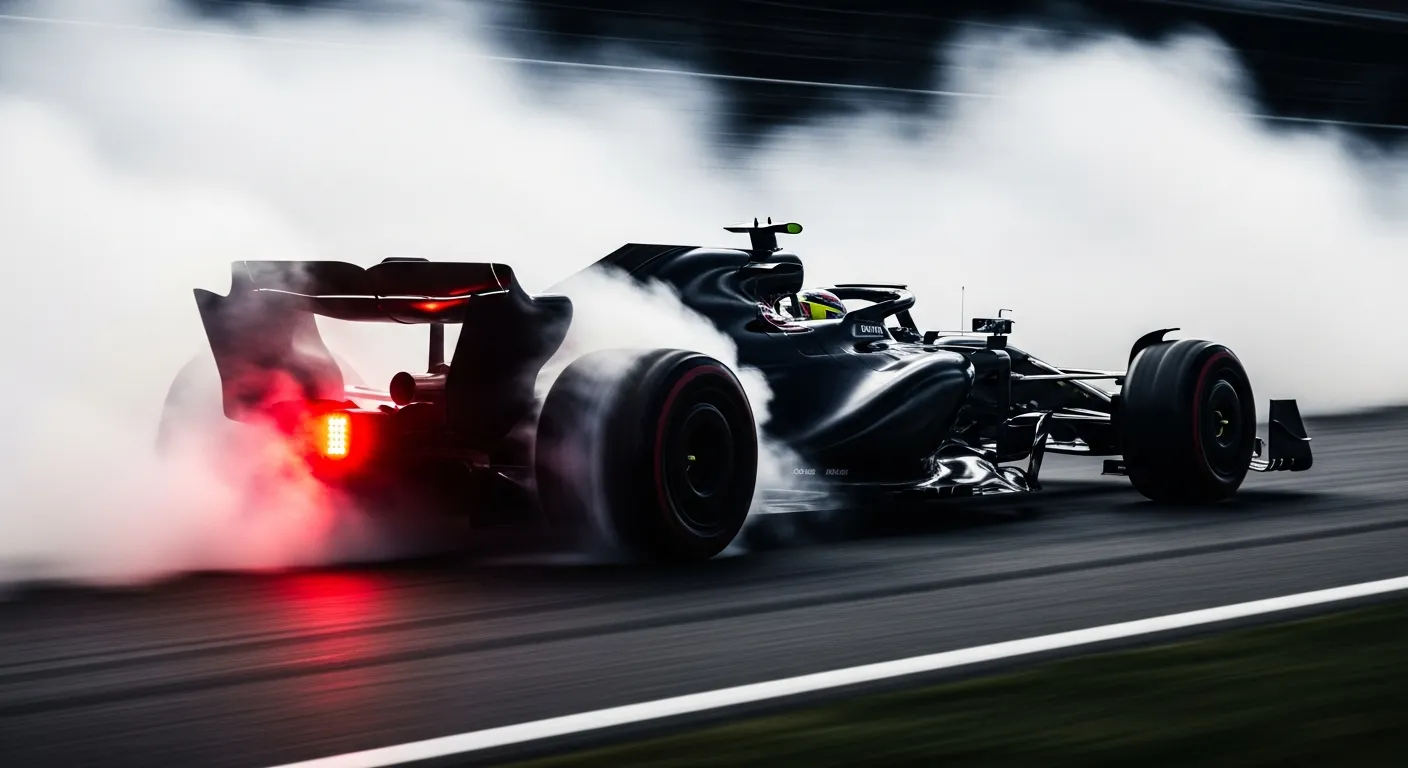
Lewis Hamilton concluded the 2025 Saudi Arabian Grand Prix in seventh position for Scuderia Ferrari, securing six points after starting from the same grid slot. This result on the demanding [Jeddah Corniche Circuit](https://www.formula1.com/en/circuits/jeddah-corniche-circuit.html) (official) saw Hamilton maintain his qualifying performance through the 50-lap race, crossing the finish line with a total time of "1:21:45.831". His fastest lap, a "1:32.600" on lap 43, placed him seventh overall in that metric for the event, indicating a consistent, if not outright challenging, pace against the frontrunners.
The race unfolded with Hamilton navigating the high-speed street circuit, holding his initial grid position despite the usual early-race jostling. While his teammate, Charles Leclerc, achieved a podium finish in third, suggesting stronger outright pace from the SF-25, Hamilton’s drive was characterized by steady lap times and effective tire management. Leclerc’s performance, including a "1:32.192" fastest lap on lap 49, positioned him second overall in the fastest lap rankings, underscoring the potential within the Ferrari package that Hamilton was working to fully unlock. The gap to the race winner, Oscar Piastri, was significant, with Piastri finishing the 50 laps in "1:21:06.758". This highlights the competitive landscape at the front of the grid, where McLaren and Red Bull demonstrated superior race pace. Hamilton's P7 finish contributed to Ferrari's constructor points, a critical aspect of the [FIA F1 World Championship](https://www.fia.com/events/fia-formula-one-world-championship) (official) standings. Examining the broader context of the season, such results are meticulously tracked by [Formula 1’s official data archives](https://www.formula1.com/en/results.html) (official). For general news and updates on the sport, the [Formula 1 official site](https://www.formula1.com/en) (official) remains a primary resource.
The Jeddah circuit, known for its unforgiving walls and rapid sections, demands precision and confidence. Hamilton's ability to maintain a clean race and convert his grid position into points showcases his enduring racecraft. While a podium eluded him in Saudi Arabia, the six points gained were a solid return for a weekend where the car's ultimate pace seemed to place it just outside the top tier. For comparison, one might recall the strategic battles seen at circuits like COTA, as in [Lewis Hamilton at the 2017 United States Grand Prix](/results/2017-cota-lewis-hamilton), where race management was key. The detailed telemetry and performance metrics, often available through [comprehensive F1 data platforms](https://api.jolpi.ca/ergast/f1/2026.json) (data), would further illuminate the nuances of Hamilton's stint. Understanding the technical regulations that govern car development, as outlined on [Wikipedia's Formula One page](https://en.wikipedia.org/wiki/Formula_One) (wiki), is crucial to appreciating the challenges teams face in optimizing performance. This outcome provides valuable data for Scuderia Ferrari as they continue to develop the SF-25. The consistent points finishes, even when not on the podium, are vital for championship aspirations, a lesson learned across many seasons for drivers like [Max Verstappen at the 2017 United States Grand Prix](/results/2017-cota-max-verstappen) and [Fernando Alonso at the 2017 United States Grand Prix](/results/2017-cota-fernando-alonso), whose careers demonstrate the long game of F1.
Verified race record · Ergast
Grid
P7
Finish
P7
Points
6
Laps
50
Constructor
Scuderia Ferrari
Status
Finished
Teammate that weekend
Charles Leclerc
Grid P4 · Finish P3 · 15 pts
Championship · before vs after
Before round 5
P725 pts
After round 5
P731 pts