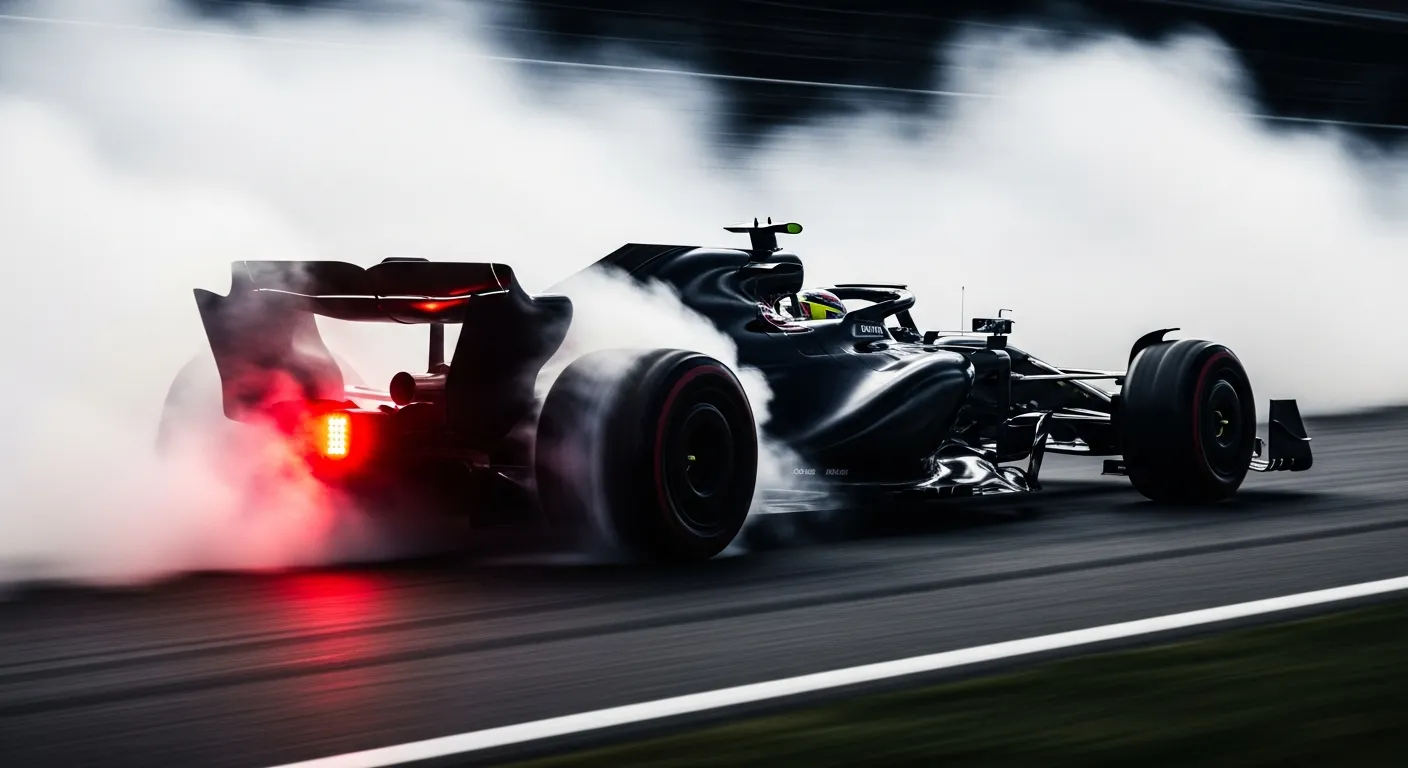
A flat spot is a localized area of severe wear on a Formula 1 tire, resulting from the wheel locking up under heavy braking. This phenomenon creates a literal flat section on the tire's otherwise round circumference, with immediate and detrimental effects on the car's performance and driver comfort.
The Mechanics of a Flat Spot
When a driver brakes aggressively, particularly into a corner, there's a risk of exceeding the tire's grip limit, causing one or more wheels to stop rotating while the car is still moving. This "locking up" means the tire surface is dragged across the asphalt, generating immense friction and heat in that specific contact patch. The rubber in this area rapidly abrades, leading to a visible flat section. The severity depends on speed, duration of the lock-up, and the tire compound. Even a momentary lock-up can cause enough damage to compromise a stint. The FIA Formula One regulations emphasize safety, and a severely flat-spotted tire can be deemed unsafe due to structural integrity concerns or potential failure.
Race Impact and Consequences
The immediate consequence of a flat spot is a significant vibration transmitted through the car, which can be felt through the steering wheel and chassis. This vibration not only makes the car incredibly uncomfortable to drive but also compromises handling, reducing grip and making it difficult for the driver to maintain a consistent line or brake effectively. A flat-spotted tire effectively loses its optimal contact patch with the track, impacting the car's ability to generate Downforce through its tires. The uneven wear can also lead to balance issues, making the car unpredictable, especially at high speeds or under braking. For a deeper dive into the basic concept, the flat spot — Wikipedia glossary entry provides a good foundation.
In a race, a flat spot often necessitates an unscheduled pit stop. Continuing on a severely damaged tire risks further performance degradation, potential delamination, or even a complete tire failure, which could lead to a dangerous accident. This forced stop costs valuable track position and can completely derail a meticulously planned race strategy. Teams, in collaboration with tire supplier Pirelli, constantly monitor tire wear and temperature, making decisions on when to pit.
Notable Instances and Viewer Confusion
Flat spots are a common occurrence, particularly during qualifying laps where drivers push the limits, or in race scenarios involving intense wheel-to-wheel combat. Valtteri Bottas, for instance, has had several high-profile flat spots throughout his career, notably at the 2020 Sakhir Grand Prix, where a lock-up early in the race severely hampered his performance and strategy. Lewis Hamilton also famously suffered a significant flat spot at the 2020 British Grand Prix, yet managed to nurse his car to victory despite the extreme vibrations and a rapidly deflating tire in the final laps.
Viewers often wonder why such a seemingly minor imperfection can have such a profound impact. The answer lies in the extreme precision and fine margins of Formula 1. F1 cars operate at the absolute edge of performance, where every millisecond and every millimeter of tire contact counts. A flat spot disrupts the delicate aerodynamic balance and mechanical grip, making the car less predictable and slower. It's not just about the visible damage; it's about the systemic disruption to the car's entire performance envelope, including how it interacts with the track via its Ground Effect and maintains optimal Ride Height under load.
Common questions
- Can a flat spot be repaired during a race?
- No, a flat spot cannot be repaired mid-race. Once a tire is flat-spotted, it must be replaced during a pit stop. Teams will often try to manage a minor flat spot to avoid a stop, but severe damage necessitates a change to maintain safety and performance.
- What causes a flat spot?
- Flat spots primarily result from wheels locking up under heavy braking, often due to driver error, an imbalance in brake bias, or cold tires lacking optimal grip. The wheel stops rotating while the car is still moving, dragging the tire across the track surface.