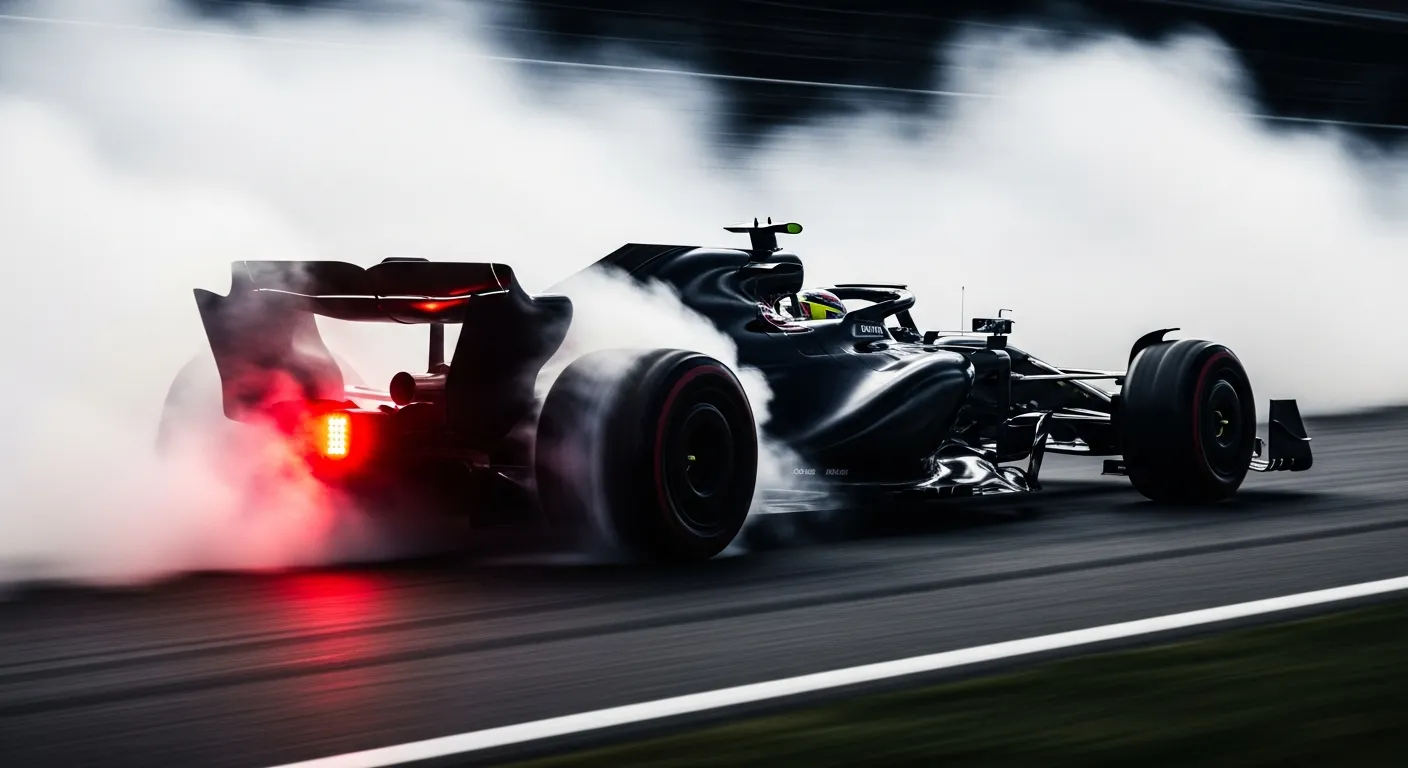
The Mechanics of a Lock-Up
A lock-up in Formula 1 is the sudden, uncontrolled cessation of rotation of one or more wheels while the car is still in motion, caused by excessive braking force. This critical moment happens when the driver applies so much pressure to the brake pedal that the hydraulic system overwhelms the tire's available grip on the tarmac. With the wheel no longer rotating, the tire slides across the track surface, generating immense friction and heat. Unlike road cars, Formula 1 cars are not equipped with Anti-lock Braking Systems (ABS), meaning drivers must modulate braking pressure manually to avoid this phenomenon, a testament to the raw skill required at the pinnacle of motorsport.
Race Impact and Consequences
Lock-ups most frequently occur during heavy braking zones, particularly when approaching tight corners, hairpins, or complex chicanes on a permanent circuit. The immediate consequences are manifold and detrimental to a driver's race. Firstly, the car's steering capability is severely compromised, leading to understeer as the front wheels cease to provide directional control. This often causes the car to run wide, miss the apex, potentially hit a kerb aggressively, or even go off track entirely. Secondly, and perhaps more critically, a lock-up results in a significant time loss as the driver must momentarily release the brakes, re-establish tire rotation and grip, and then re-apply braking pressure more judiciously.
The most damaging consequence, however, is the creation of a "flat spot" on the affected tire. This is a literal flat patch worn into the tire's circumference from the intense friction of sliding. A flat-spotted tire causes severe vibrations through the car, compromises grip, and accelerates tire degradation. Depending on its severity, a flat spot can force an unscheduled pit stop for fresh Pirelli tires, completely disrupting a team's race strategy and costing valuable track position. Such incidents can dramatically alter the outcome of a Grand Prix, turning a strong performance into a recovery drive.
Driver Skill and Mitigation
Avoiding lock-ups is a constant challenge, even for the most experienced drivers. It's a delicate balance between extracting maximum braking performance and exceeding the tire's grip limit. Drivers constantly adjust their brake bias (the distribution of braking force between the front and rear axles) – often with real-time advice from their Race Engineer – to suit changing track conditions, fuel loads, and tire wear. Techniques like trail braking, where brake pressure is gradually reduced as the car turns into a corner, are crucial for maintaining control. While modern F1 cars are marvels of engineering, the fundamental physics of braking and tire adhesion remain, governed by the overarching FIA Formula One regulations that ensure a challenging, skill-based competition. Even under immense pressure, mastering this aspect is key to consistent performance.
Common Misconceptions
For new viewers, a lock-up might sometimes be confused with simply running wide or making a minor error. However, a true lock-up is a distinct and often dramatic event, characterized by the visible plume of smoke and the audible screech of a skidding tire. It's not merely a missed apex; it's the physical manifestation of a wheel ceasing rotation while the car is still in motion. For a more general understanding of this and other motorsport terms, the Wikipedia glossary entry for 'lock up' provides additional context.
Common questions
- Why don't F1 cars have ABS to prevent lock-ups?
- Formula 1 regulations prohibit ABS to emphasize driver skill. Drivers must manually modulate braking pressure, making lock-ups a potential consequence of pushing the limits, adding to the challenge and spectacle of the sport.
- What is a 'flat spot' and why is it bad?
- A flat spot is a worn, flat patch on a tire's circumference caused by a lock-up. It creates severe vibrations, reduces grip, and can necessitate an unscheduled pit stop, costing valuable time and track position.