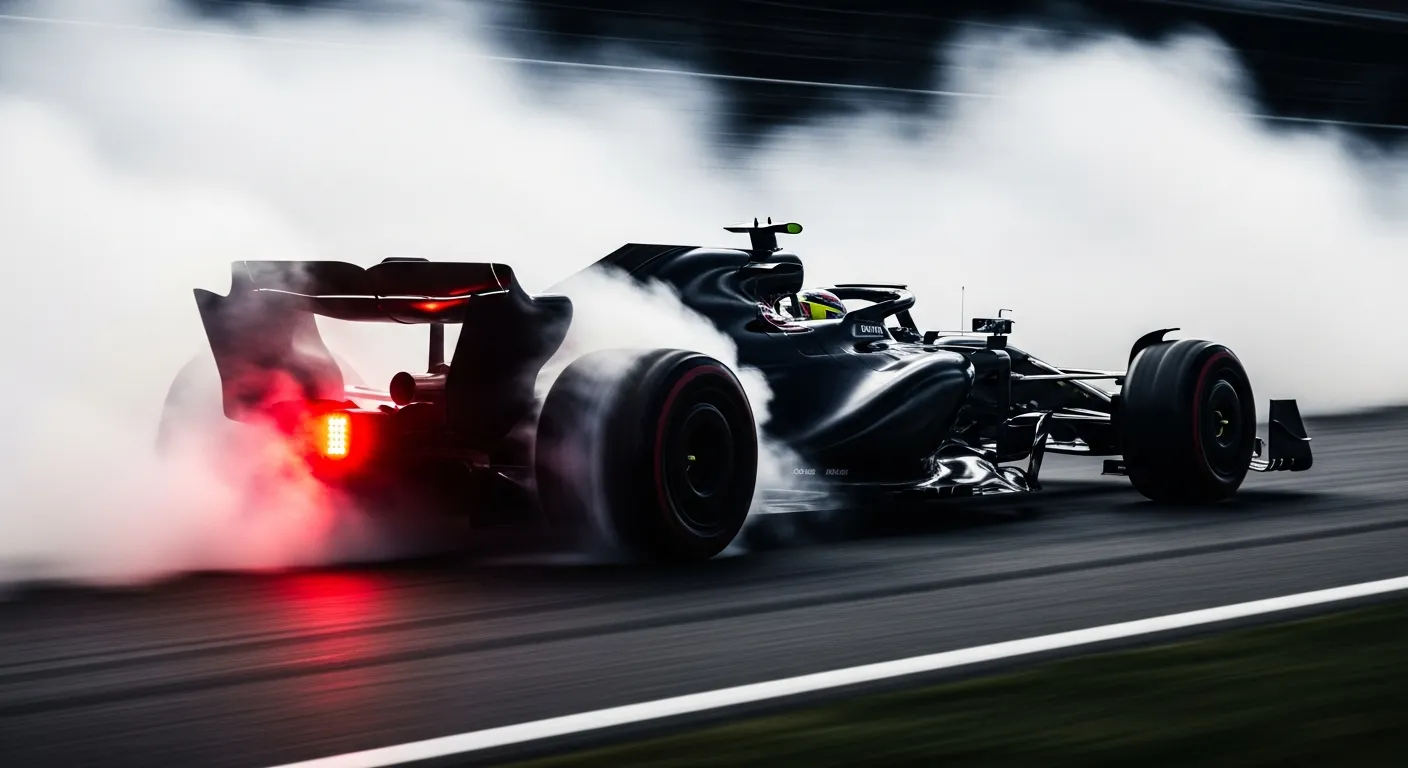
The racing line is the meticulously calculated, fastest trajectory a Formula 1 car can take through a corner and around an entire circuit, balancing grip, speed, and momentum to achieve the optimal lap time. It's not simply the shortest path, but rather the path that allows a driver to carry the most speed through corners and onto straights, maximizing acceleration and minimizing braking. This ideal path is fundamental to competitive driving in Formula 1.
The Principles of the Racing Line
At its core, the racing line embodies the "slow in, fast out" philosophy. Drivers aim to brake early and hard, turn into the corner, hit the apex (the innermost point of the corner), and then accelerate out as quickly as possible, unwinding the steering wheel. This approach effectively straightens out the corner as much as possible, allowing for a higher average speed. The precise braking points, turn-in points, apexes, and throttle application define this ideal path, which is honed through practice and extensive data analysis. Every millimeter of the track surface can influence grip, and drivers are constantly searching for the perfect line, as detailed in resources like the racing line — Wikipedia glossary entry.
When the Racing Line Matters Most
The racing line is paramount in every session, but its importance is highlighted in specific scenarios. In qualifying, drivers push the absolute limits to secure pole position by stringing together the perfect racing line for a single, blistering lap. During a race, maintaining this optimal path is crucial for consistency, managing tire degradation, and setting the fastest lap.
However, the racing line also becomes a strategic battleground. When a driver is defending, they might intentionally move off the ideal line to block an opponent, forcing them to take a wider, slower path. Conversely, an attacking driver might seek to exploit a momentary deviation or a less-than-perfect line from their rival to execute an overtake. Think of the tight chicanes at Monza or the sweeping turns of Suzuka, where even a slight deviation can cost crucial tenths of a second and dictate the outcome of a battle.
Common Misconceptions and Deviations
Viewers sometimes wonder why drivers intentionally move off the racing line. There are several reasons. In wet conditions, the traditional racing line can become saturated with water and lose grip. Drivers will then seek out a "dry line" — a path where other cars have pushed water away, or even drive off-line to find more grip on less-used tarmac. This was notably seen at the 2021 Turkish Grand Prix, where drivers actively sought out the wet parts of the track for better grip on intermediate tires.
Another reason for deviating is tire management. Drivers might move off-line on straights to cool their tires or pick up rubber. When battling, a driver might take a wider entry to a corner to get a better exit, sacrificing speed into the corner for greater momentum out of it. It’s also common to see drivers "scrubbing" their tires off the racing line during safety car periods to keep them warm and clean. The FIA Formula One regulations also dictate track limits, meaning drivers must stay within the defined boundaries, even if a slightly wider path might technically offer more speed. Tire compounds, supplied by manufacturers like Pirelli — tire compound + regulation context, also play a role, as different compounds have varying optimal operating temperatures and degradation characteristics, influencing how drivers manage their line.
Common questions
- Is the racing line always the same?
- No. While a theoretical ideal exists, it changes based on track conditions (wet/dry), tire wear, fuel load, and strategic objectives like defending or attacking. Drivers constantly adapt their line to optimize performance.
- Can two cars use the same racing line simultaneously?
- In theory, no. The racing line is a single optimal path. When two cars try to occupy it, contact or a deviation from the ideal line for at least one driver is almost inevitable, leading to slower cornering and potential loss of position.
- How do drivers learn the racing line?
- Through extensive practice, simulator work, analyzing telemetry data, and studying onboard footage. They refine it lap after lap, constantly searching for marginal gains and adapting to changing track conditions.