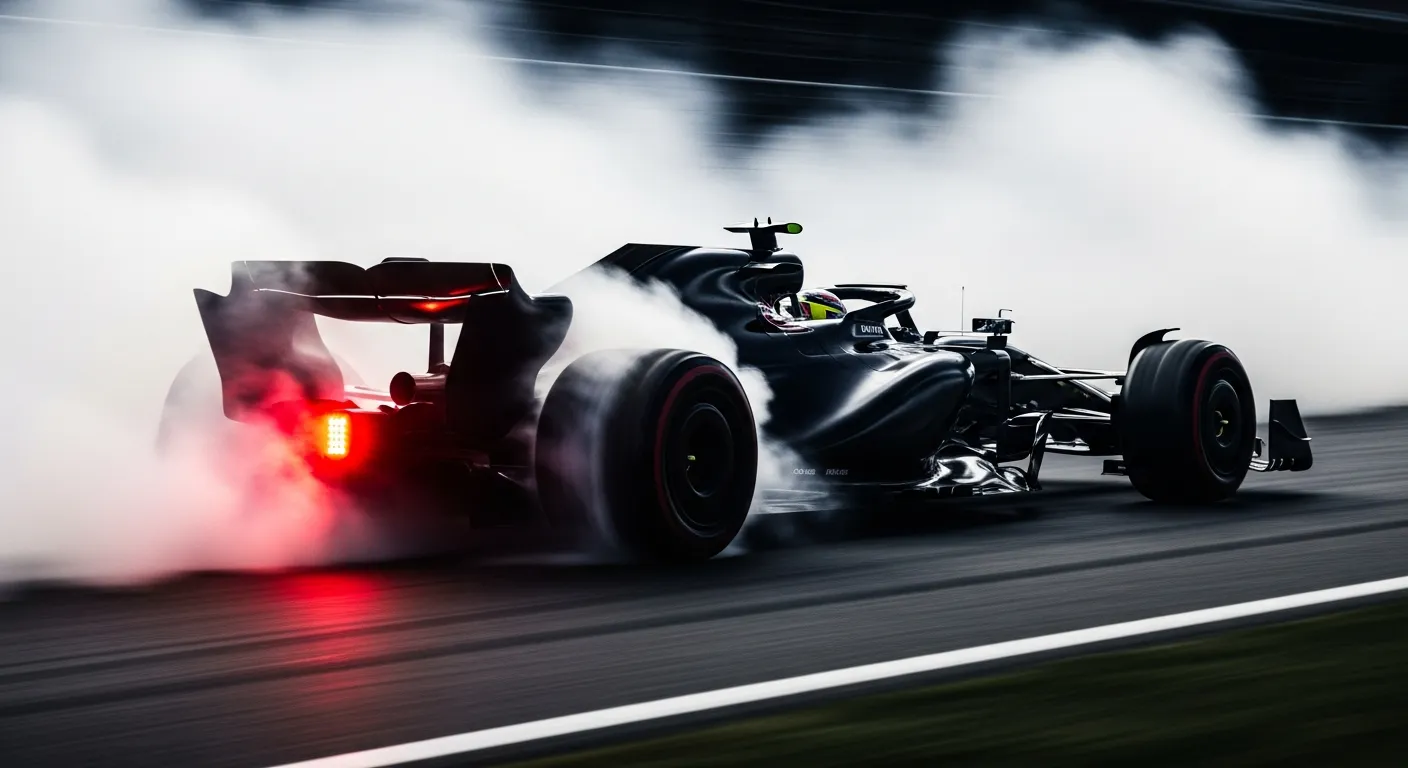
The 2014 Japanese Grand Prix at Suzuka saw Lewis Hamilton deliver a commanding performance, converting a second-place grid start into a decisive victory over his Mercedes teammate Nico Rosberg amidst challenging wet conditions. This particular race was a pivotal moment in Hamilton's pursuit of the 2014 Drivers' Championship, showcasing his exceptional wet-weather driving prowess and strategic race management. The Grand Prix, held on October 5, 2014, was significantly impacted by the persistent heavy rain brought by Typhoon Phanfone, necessitating a safety car start and leading to multiple interruptions throughout the event. Hamilton, starting from P2 alongside pole-sitter Rosberg, initially trailed his teammate in the early running. However, as the conditions evolved and the field navigated the treacherous [Suzuka Circuit](https://www.formula1.com/en/circuits/japan/suzuka-circuit.html), Hamilton began to demonstrate superior pace. His astute tire management and aggressive yet controlled driving allowed him to steadily close the gap to Rosberg. On lap 29, Hamilton executed a decisive and clean overtake on Rosberg into Turn 1, seizing the lead. From that moment, he maintained an unassailable advantage, relentlessly pushing the Mercedes W05 Hybrid. His dominance was further underscored by setting the fastest lap of the race on lap 39, a blistering 1:51.600, at an average speed of 187.322 kph, a clear indication of his mastery over the challenging wet track. This performance was a testament to both Hamilton's raw talent and the formidable engineering of the [Mercedes-Benz F1 W05 Hybrid](https://en.wikipedia.org/wiki/Mercedes-Benz_F1_W05_Hybrid), a car that proved to be the class of the field throughout the 2014 season.
Hamilton completed all 44 laps of the shortened race in a total time of 1:51:43.021, securing the maximum 25 points for the victory. His triumph widened his championship advantage over Rosberg, who finished 9.180 seconds behind him in P2, reinforcing the intense intra-team battle that defined their season. The race, however, was tragically overshadowed by a severe accident involving Marussia driver Jules Bianchi, which occurred in the closing stages under double yellow flags. This incident ultimately led to the race being red-flagged and the results declared after 44 laps, casting a somber mood over what had been a thrilling on-track battle. Such grave events serve as a stark reminder of the inherent risks in [Formula 1 racing](https://www.fia.com/events/fia-formula-one-world-championship) and the continuous efforts in enhancing driver safety, guided by the [FIA's stringent technical regulations](https://www.fia.com/regulation/category/110). While Hamilton celebrated his win, the gravity of Bianchi's accident resonated deeply within the paddock. This particular Grand Prix remains a critical and emotionally charged chapter in Hamilton's 2014 championship bid, showcasing his ability to perform under immense pressure and adverse conditions, a characteristic evident throughout his career, including his strategic drive at the [2017 Bahrain Grand Prix](/results/2017-bahrain-lewis-hamilton) where he also navigated a complex race to a podium finish. For those interested in historical data trends, the [Jolpica/Ergast F1 data](https://api.jolpi.ca/ergast/f1/2026.json) provides comprehensive records for the sport, allowing for comparisons across seasons and eras, perhaps even to understand the trajectory of drivers like [Fernando Alonso at the 2017 Bahrain Grand Prix](/results/2017-bahrain-fernando-alonso) or the early career development of talents such as [Max Verstappen at the 2017 Bahrain Grand Prix](/results/2017-bahrain-max-verstappen). More general information on the sport can be found on [Wikipedia: Formula One](https://en.wikipedia.org/wiki/Formula_One). The 2014 Japanese Grand Prix at Suzuka is thus etched into F1 history, not only for Hamilton's brilliant drive but also for the tragic circumstances that unfolded, leaving a lasting impact on the sport.
Verified race record · Ergast
Grid
P2
Finish
P1
Points
25
Laps
44
Constructor
Mercedes AMG F1
Status
Finished
Teammate that weekend
Nico Rosberg
Grid P1 · Finish P2 · 18 pts
Championship · before vs after
Before round 15
P1241 pts
After round 15
P1266 pts