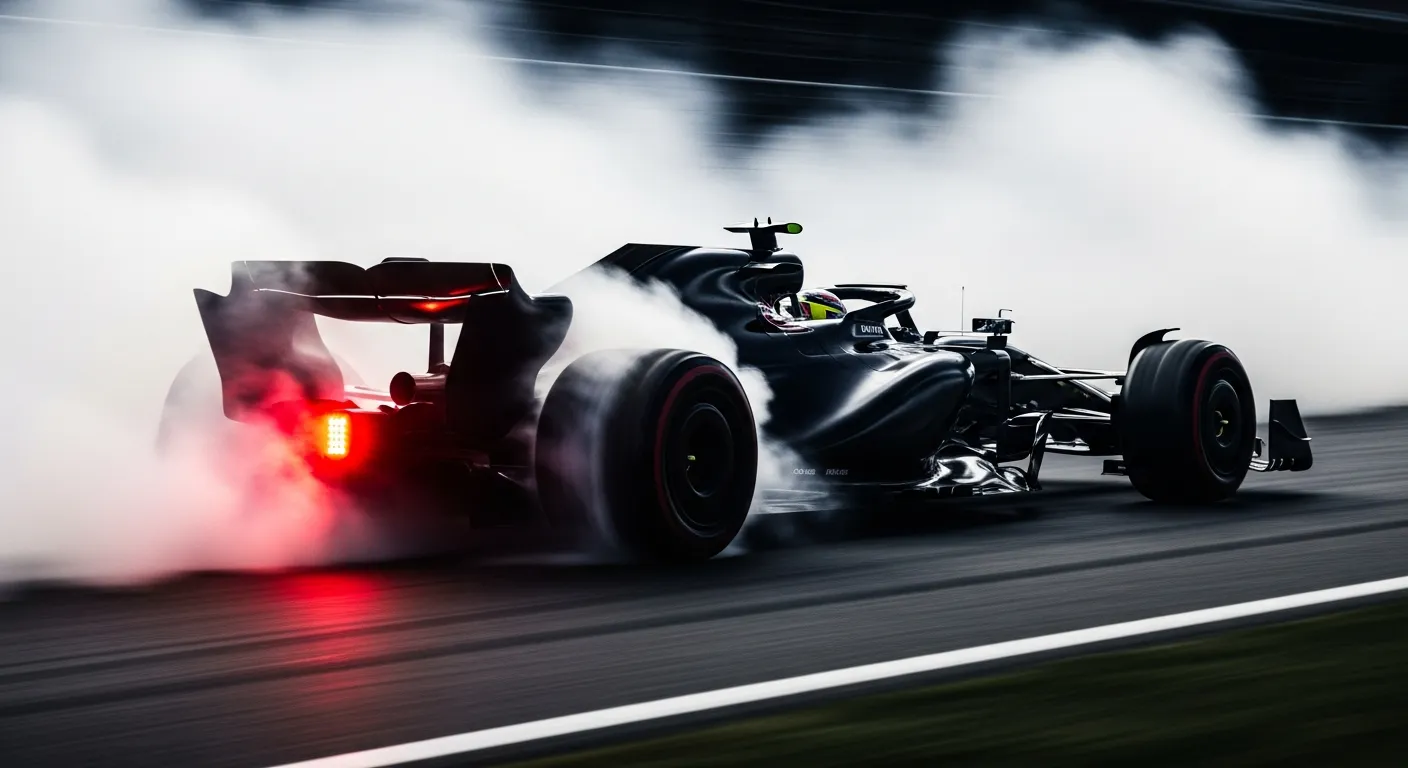
Lewis Hamilton's victory at the 2017 Spanish Grand Prix on May 14, 2017, was a demonstration of strategic execution and raw pace, culminating in a commanding win from pole position at the Circuit de Barcelona-Catalunya. Hamilton began the 66-lap race from grid position 1, immediately engaging in a strategic battle with Sebastian Vettel, who started alongside him. The Mercedes driver navigated the initial phases of the race with precision, maintaining his lead through the opening stints. The team's strategy was critical, particularly as his teammate, Valtteri Bottas, who started from grid position 3, retired on lap 38 due to a power unit issue, leaving Hamilton as the sole Mercedes contender. This placed additional pressure on Hamilton to deliver, and he responded by controlling the race pace. The Circuit de Barcelona-Catalunya, known for its demanding layout and strategic complexity, proved to be a fitting stage for this contest. For a broader understanding of how these races contribute to the overall [FIA
F1 World Championship](https://www.fia.com/events/fia-formula-one-world-championship) standings, the official resources provide comprehensive details. The intricate details of race weekends, including qualifying and practice sessions, are meticulously documented on the [Formula 1
official site](https://www.formula1.com/en).
As the race progressed, Hamilton refined his pace, ultimately setting the fastest lap of the race on lap 64 with a time of 1:23.593, demonstrating the W08's capabilities. He completed the 66 laps in a total time of 1:35:56.497, securing 25 points for his Mercedes team. This performance contrasted with the challenges faced by other drivers, such as [Carlos Sainz at the 2022 Chinese Grand Prix](/results/2022-shanghai-carlos-sainz), who also had to contend with competitive midfield battles. The race saw Daniel Ricciardo secure a podium finish, while Force India drivers Sergio Pérez and [Esteban Ocon at the 2022 Chinese Grand Prix](/results/2022-shanghai-esteban-ocon) also delivered strong performances, finishing 4th and 5th respectively, both completing 65 laps. Such results highlight the competitive nature of Formula 1, which you can explore further on the [Formula 1
official site](https://www.formula1.com/en) for detailed race reports. The comprehensive historical race data, including specific driver and constructor performance metrics, can be found via resources like [Jolpica/Ergast
2026 season data](https://api.jolpi.ca/ergast/f1/2026.json), offering insight into the sport's evolution. Understanding the technical aspects and regulations governing these high-performance machines is also key, as discussed on [Wikipedia: Formula One](https://en.wikipedia.org/wiki/Formula_One). The strategic nuances of tyre management and pit stops were crucial for Hamilton, allowing him to manage the gap to Vettel effectively. This particular race was a pivotal moment in the 2017 season, setting a benchmark for subsequent rounds, much like the strategic decisions seen in races involving drivers such as [Alexander Albon at the 2022 Chinese Grand Prix](/results/2022-shanghai-alex-albon). Further insights into the season's progression and championship battles are available through the [FIA
F1 World Championship](https://www.fia.com/events/fia-formula-one-world-championship) archives.
Verified race record · Ergast
Grid
P1
Finish
P1
Points
25
Laps
66
Constructor
Mercedes AMG F1
Status
Finished
Teammate that weekend
Valtteri Bottas
Grid P3 · Engine · 0 pts
Championship · before vs after
Before round 5
P273 pts
After round 5
P298 pts