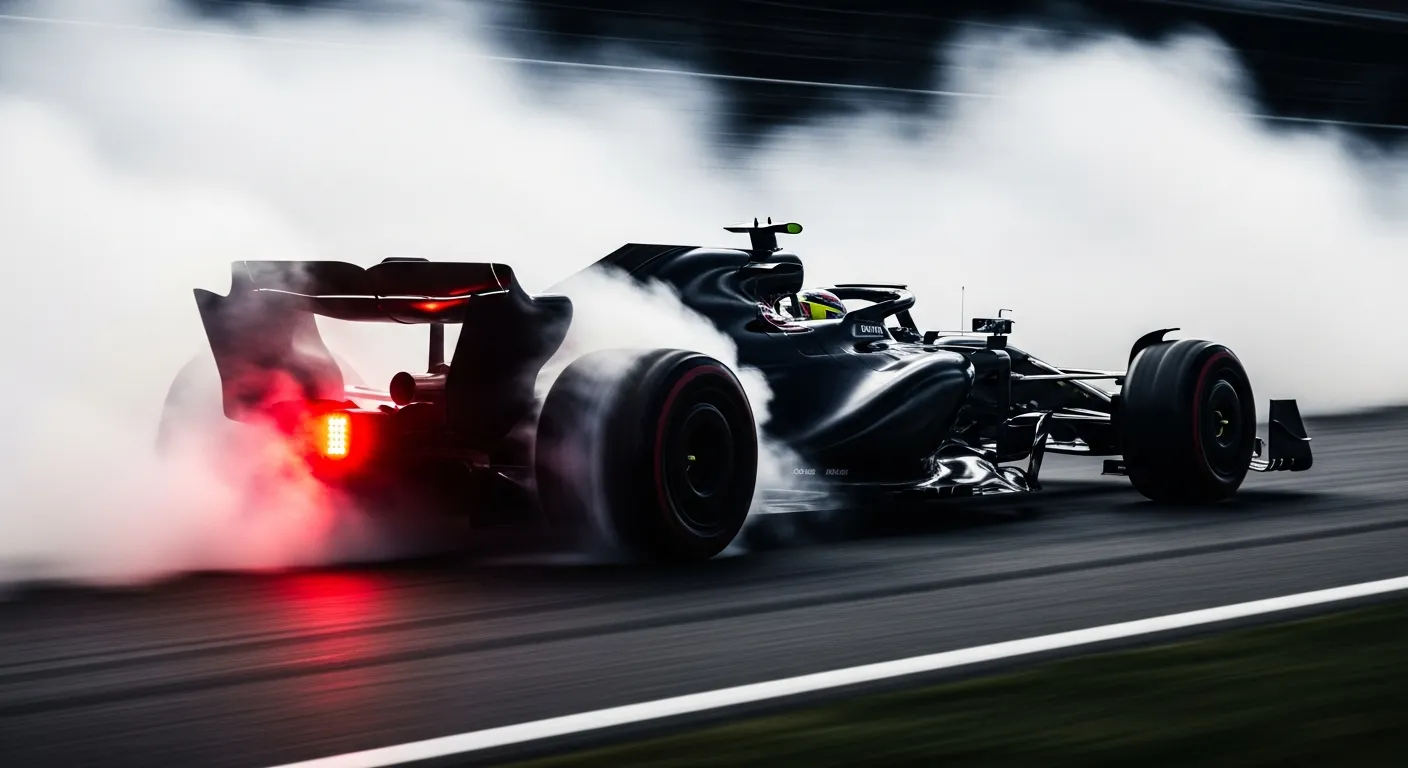
Charles Leclerc navigated the challenging Circuit Park Zandvoort with strategic precision at the 2024 Dutch Grand Prix, demonstrating Scuderia Ferrari's capacity to climb through the field from a P6 grid slot to secure a valuable podium finish. Starting from sixth on the grid, Leclerc executed a calculated race, consistently managing his pace and tire degradation across the 72 laps of the demanding Dutch circuit. His ability to maintain a strong race rhythm was evident, culminating in a fastest lap on lap 62 with a time of 1:14.585, ranking him seventh overall in the speed stakes for the event. This performance was critical for Ferrari, particularly when contrasted with the pole-sitting Lando Norris of McLaren, who ultimately claimed victory with a total time of 1:30:45.519, and the home hero Max Verstappen, who finished second for Red Bull Racing. Leclerc's final race time of 1:31:10.958 underscored a robust drive, securing 15 crucial points for his championship bid. The unique characteristics of Zandvoort, with its high-speed banking and limited overtaking opportunities, make such a progression from P6 to P3 a testament to both driver skill and the effectiveness of the Ferrari 2024 package. For a broader understanding of the season's competitive landscape, insights into the [Formula 1 — official site](https://www.formula1.com/en) often highlight such strategic drives and their impact on the constructors' battle.
The Monégasque driver's performance also stood in interesting contrast to his teammate, Carlos Sainz Jr., who started tenth and finished fifth, demonstrating a collective strong outing for Scuderia Ferrari. Sainz's fastest lap, a 1:14.117 on lap 40, was notably quicker than Leclerc's, ranking fourth overall, indicating different strategic approaches or tire windows employed across the garage. Leclerc's podium finish at Zandvoort adds another significant result to his 2024 campaign, where consistency and opportunistic driving have been key factors. This result builds on the kind of strategic thinking seen in other challenging races, perhaps reminiscent of the tactical battles observed with drivers like [Max Verstappen at the 2016 Australian Grand Prix](/results/2016-albert-park-max-verstappen) or even [Carlos Sainz at the 2015 Abu Dhabi Grand Prix](/results/2015-yas-marina-carlos-sainz), who have also demonstrated strong recovery drives. The intricacies of race strategy and car performance are often detailed by the [FIA — F1 World Championship](https://www.fia.com/events/fia-formula-one-world-championship) regulations and technical directives. Understanding the historical context of such performances can be found on resources like [Wikipedia: Formula One](https://en.wikipedia.org/wiki/Formula_One), which chronicles the sport's evolution and key events. Data analysis, such as that provided by [Jolpica/Ergast — 2026 season data](https://api.jolpi.ca/ergast/f1/2026.json), helps quantify these efforts, offering a granular view of lap times and race pace. This race further solidified Leclerc's standing, adding to his points tally and maintaining his third position in the drivers' championship, a testament to his consistent form. The resilient performance of drivers like [Lewis Hamilton at the 2016 Australian Grand Prix](/results/2016-albert-park-lewis-hamilton), who also navigated challenging races from mid-grid positions, provides a historical parallel for such determined drives. Further details on race specifics and driver performance can be found on the [Formula 1 — official site](https://www.formula1.com/en) and through official [FIA — F1 World Championship](https://www.fia.com/events/fia-formula-one-world-championship) reports, which offer comprehensive post-race analyses.
Verified race record · Ergast
Grid
P6
Finish
P3
Points
15
Laps
72
Constructor
Scuderia Ferrari
Status
Finished
Teammate that weekend
Carlos Sainz Jr.
Grid P10 · Finish P5 · 10 pts
Championship · before vs after
Before round 15
P3177 pts
After round 15
P3192 pts