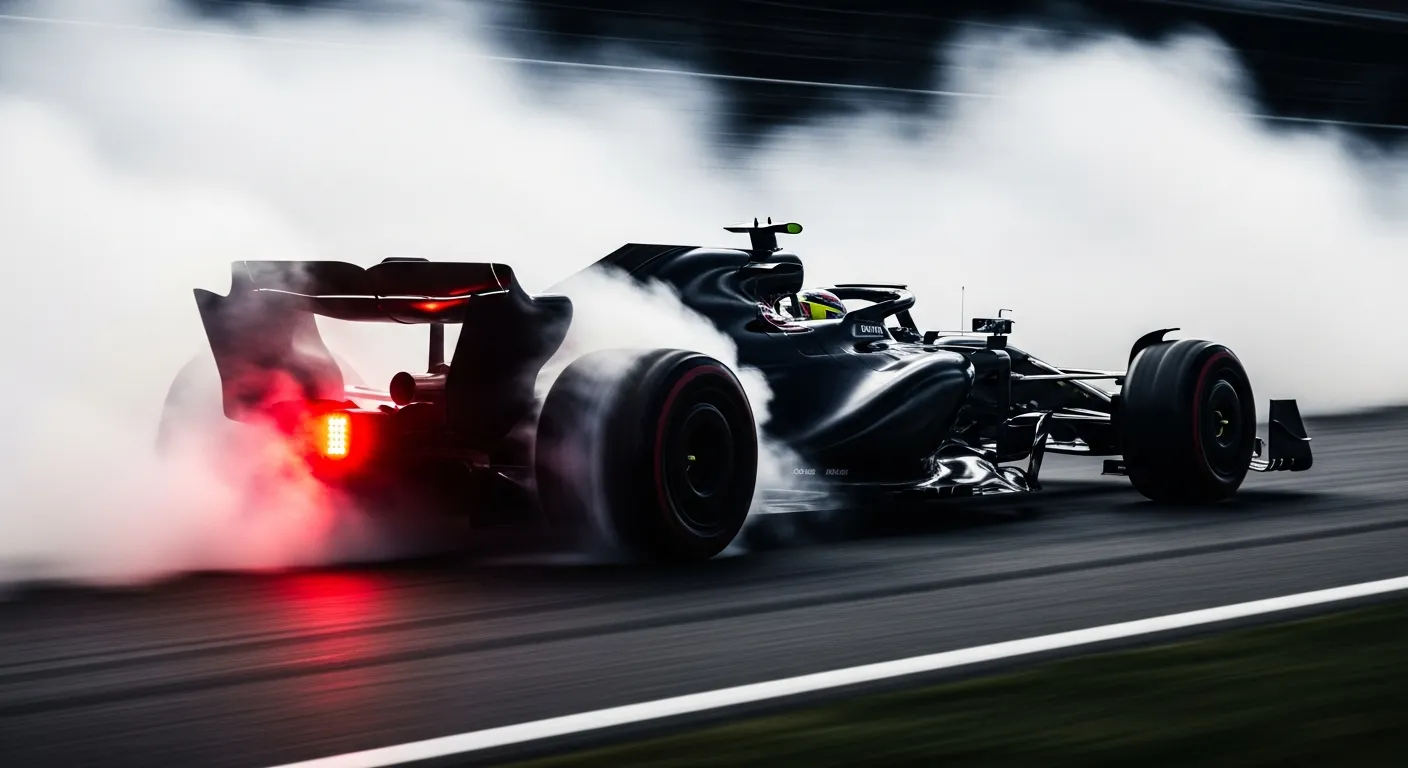
Turbo lag, in the context of Formula 1, specifically refers to the momentary delay between a driver demanding power from the engine and the turbocharger fully spooling up to deliver that power. This phenomenon is inherent to turbocharged engines, where exhaust gases drive a turbine, which in turn spins a compressor to force more air into the engine cylinders, boosting power. The time it takes for these components to accelerate to the required speed creates the 'lag'.
The Hybrid Era's Solution
Before the V6 turbo-hybrid era began in 2014, naturally aspirated F1 engines offered instant throttle response. The reintroduction of turbochargers brought the challenge of lag back into focus. However, modern Formula 1 power units employ sophisticated technology to mitigate this. A key component is the MGU-H (Motor Generator Unit – Heat), which is directly connected to the turbocharger shaft. This electrical motor can spin the turbo up to speed independently of exhaust gases, effectively pre-spooling it and virtually eliminating the traditional delay. This intricate system is a cornerstone of the FIA Formula One regulations governing power unit design.
Impact on Driving and Performance
While the MGU-H has dramatically reduced its impact, turbo lag remains a critical consideration for engineers and drivers. On corner exit, immediate power delivery is paramount for optimal acceleration and lap time. A car with even a fraction of a second of perceptible lag will struggle to match rivals who can put power down instantly. This affects not just outright speed but also the driver's confidence and ability to manage tire grip, especially with high-performance Pirelli — tire compound + regulation context. The way power is delivered to the wheels, managed by systems like the Differential and influenced by driver inputs such as Brake Bias, is constantly optimized to ensure maximum traction and minimal delay. Early in the hybrid era, some power unit manufacturers demonstrated superior MGU-H integration, providing their teams with a significant advantage in driveability and response out of slow corners.
Common Misconceptions
For viewers, turbo lag can sometimes be conflated with other issues like poor traction or an overly aggressive throttle map. While these can manifest similarly on track – a car struggling to accelerate smoothly – true turbo lag is a specific mechanical characteristic of the turbocharger's response time. The advanced electronics and energy recovery systems within the F1 power unit work tirelessly to make this delay almost imperceptible, yet the fundamental principle of turbo lag — Wikipedia glossary entry remains a design challenge. The packaging of these complex components within the car's structure, including areas like the Sidepod, also plays a role in overall performance and heat management, indirectly influencing how effectively the turbo system operates.
Common questions
- What caused turbo lag in older F1 cars?
- Older turbocharged F1 cars lacked the sophisticated electronic controls and energy recovery systems of modern units, making the mechanical delay in the turbo's spooling more pronounced.
- How do modern F1 cars minimize turbo lag?
- Modern F1 hybrid power units use the MGU-H (Motor Generator Unit – Heat) connected to the turbocharger. This unit can electrically spin the turbo, effectively pre-spooling it and eliminating the traditional delay.
- Is turbo lag still a factor in F1 today?
- While significantly mitigated by the MGU-H, slight variations in turbo response can still influence car setup and driver feel, especially in specific cornering scenarios or under varying atmospheric conditions.