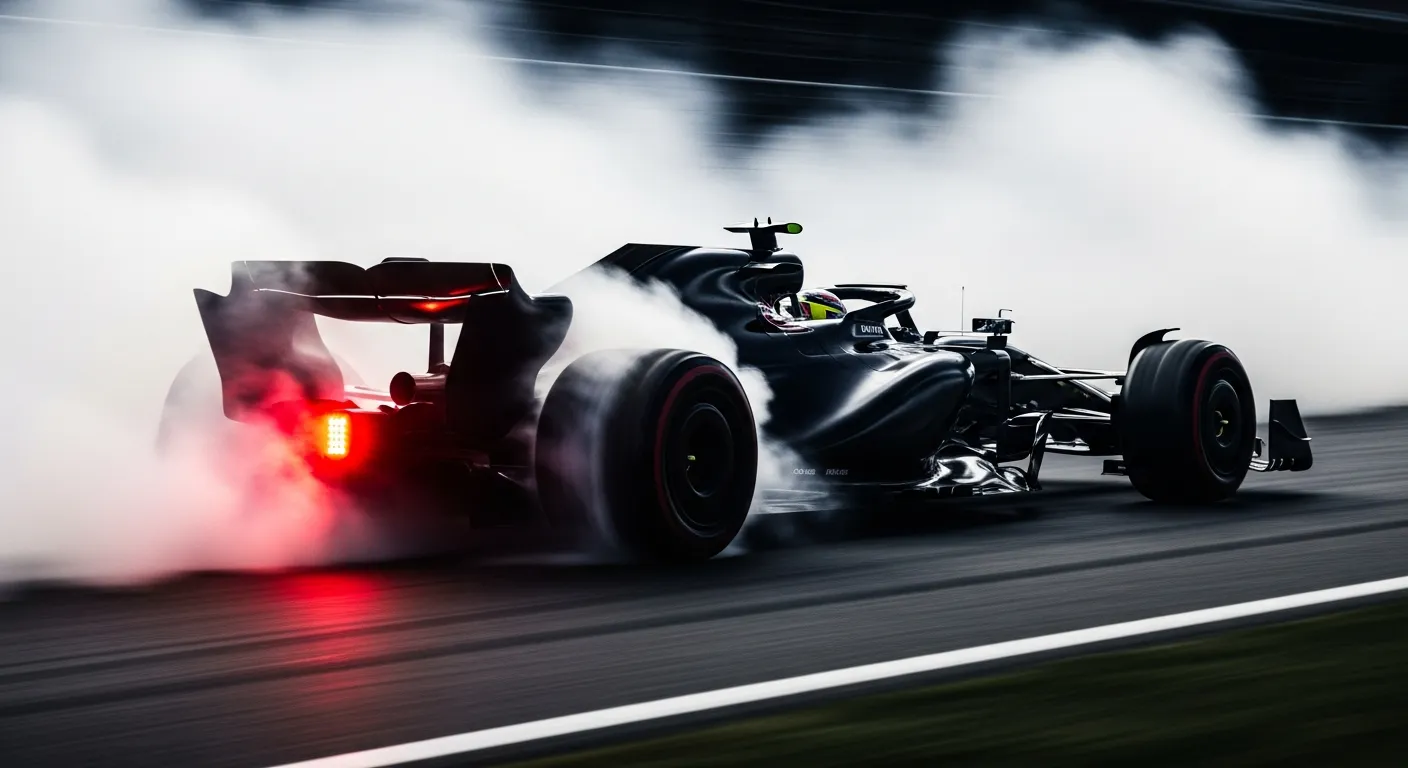
The 2014 Australian Grand Prix marked a challenging start to Lewis Hamilton's championship campaign, as his Mercedes W05 suffered an engine failure just two laps into the race, forcing an early retirement from pole position. Having secured the top spot on the grid with a commanding qualifying performance, Hamilton's race began with the promise of a strong points haul at the iconic Albert Park Grand Prix Circuit. However, mechanical issues quickly intervened. His Mercedes W05, equipped with the newly introduced V6 turbo-hybrid power unit that defined the 2014 season's technical regulations, registered an "Engine" status, bringing his participation to an abrupt end. Despite recording a fastest lap of 1:49.947 on his second tour, which was ranked 20th overall among all drivers, the British driver was unable to continue, concluding his opening weekend with zero points. This early exit stood in stark contrast to his teammate Nico Rosberg's dominant victory, who started from third on the grid and completed all 57 laps to secure the maximum 25 points for Mercedes. The incident underscored the initial reliability challenges some teams faced with the radical new technical regulations introduced for the 2014 [Formula 1 season](https://www.formula1.com/en), especially concerning the complex power unit architecture. For further details on the championship structure, the [FIA F1 World Championship](https://www.fia.com/events/fia-formula-one-world-championship) provides comprehensive information.
While Hamilton's Australian Grand Prix was cut short, the underlying pace of the Mercedes package was undeniably strong, as demonstrated by Rosberg's commanding performance. This mixed outcome for Mercedes highlighted the steep learning curve for all constructors adapting to the new era of power units, a theme that would resonate throughout the early races of the year. For Hamilton, this DNF was an immediate setback, a stark reminder that even with pole position, race day can present unforeseen obstacles. It's a situation that emphasizes the fragility of early-season machinery, not entirely dissimilar to the unexpected challenges faced by drivers like [Yuki Tsunoda at the 2021 São Paulo Grand Prix](/results/2021-interlagos-yuki-tsunoda) or the strategic battles that defined races for drivers such as [Max Verstappen at the 2021 Qatar Grand Prix](/results/2021-lusail-max-verstappen). The pursuit of a championship often begins with overcoming such early hurdles, and this race certainly set a demanding tone for Hamilton's year. Analyzing [F1 historical race data](https://api.jolpi.ca/ergast/f1/2026.json) from this period reveals a common struggle with the new power unit generation. The broader context of the [FIA F1 World Championship](https://www.fia.com/events/fia-formula-one-world-championship) regulations for 2014 meant that reliability was as crucial as raw speed, a delicate balance Mercedes would need to refine quickly. For a deeper understanding of the sport's technological evolution, [Wikipedia's comprehensive overview of Formula One](https://en.wikipedia.org/wiki/Formula_One) offers valuable context on these transitional periods. The early retirement meant Hamilton joined a list of notable drivers, including four-time champion Sebastian Vettel, who also retired with an "Engine" status, indicating a wider struggle with the new power units across the grid. This race, despite its brevity for Hamilton, provided crucial data for Mercedes, informing their development path for the remainder of a season that would ultimately prove historic, contrasting sharply with later, more dominant performances like [Lewis Hamilton's win at the 2021 Qatar Grand Prix](/results/2021-lusail-lewis-hamilton). You can explore more about the sport's history and regulations on the [official Formula 1 site](https://www.formula1.com/en) and through [Wikipedia's detailed F1 history](https://en.wikipedia.org/wiki/Formula_One).
Verified race record · Ergast
Grid
P1
Finish
Power unit
Points
0
Laps
2
Constructor
Mercedes AMG F1
Status
Power unit
Teammate that weekend
Nico Rosberg
Grid P3 · Finish P1 · 25 pts